The secret molecule that awakens the follicles: the breakthrough that could change everything you know about baldness
A team from UCLA identified a molecule that stimulates hair growth in inactive follicles, showing better results than traditional treatments.

At the laboratories of the University of California, Los Angeles, a recent discovery is changing the global approach to one of the most persistent aesthetic and emotional problems: the molecule that drives hair growth. Faced with baldness, a challenge that has crossed generations and cultures, science seems to be getting closer to a real and effective solution. The research that surprised the world promises to surpass the limits of conventional remedies and open a new era in hair care.
A universal challenge that impacts self-esteem
“Most men and women will suffer, at some point, from thinning or hair loss,” stated William Lowry, a professor of molecular biology at UCLA, while analyzing the results of the recent study on the molecule PP405. Lowry's words reflect the psychological and social weight of baldness, a condition that can affect the quality of life and confidence of those who experience it. Since ancient times, people have turned to remedies as varied as they are ineffective, from exotic mixtures of ancient Egypt to Celtic and American potions, in the tireless search for a thick mane.
Today, science has identified multiple causes for hair loss: genetics, aging, hormonal imbalances, stress, side effects of medications, and even nutritional deficiencies. However, frustration persists because approved treatments—such as minoxidil or finasteride—offer limited results and do not work for everyone. Only one in three people tends to experience noticeable improvements.

A tiny molecule, a big difference
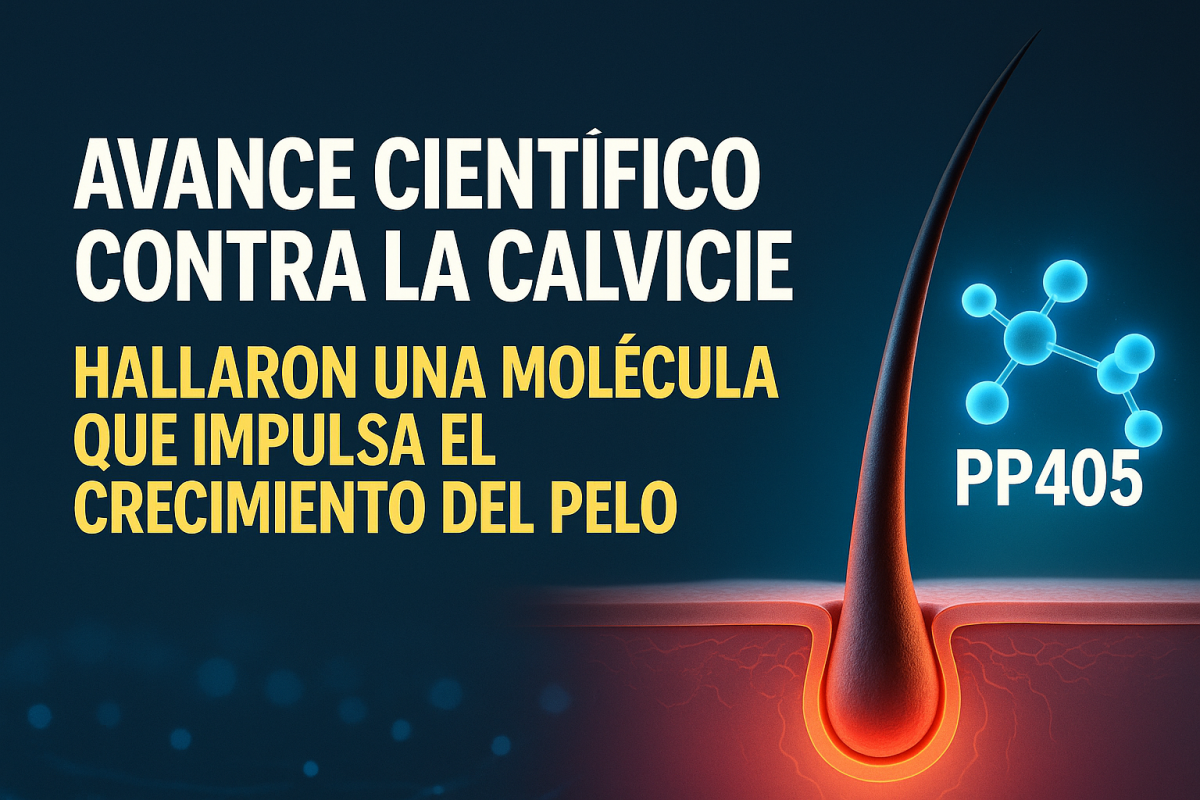
In this context, a group of scientists at UCLA managed to isolate and test a small molecule named PP405. The name is not coincidental: it refers to the famous 405 freeway in Los Angeles, a difficult road to navigate, just like the daily struggle against baldness. The team led by Lowry, along with Heather Christofk and Michael Jung, found that PP405 acts directly on a key protein in the stem cells of the hair follicle. By inhibiting it, it allows these “latent” follicles to reactivate and begin producing new, thick hair, known in medicine as terminal hair.
The validation of this hair growth-promoting molecule took nearly a decade of preclinical trials, and finally, the first human tests conducted in 2023 marked a turning point. For a week, volunteers applied PP405 to their scalps before sleeping. According to the researchers, the results were “statistically significant,” much better than those obtained with traditional treatments.
Promising results and scientific caution
Lowry and his team clarified that the effectiveness of the molecule may vary according to the genetic and biological diversity of the patients, but they emphasize that the trials demonstrated the growth of terminal hair, not just fine hair as occurs with other alternatives. “No product will work for everyone,” admitted Lowry, although he acknowledged the transformative potential of the molecule PP405 against baldness.
The enthusiasm of the researchers is not coincidental. According to UCLA's publication, hair loss affects more than half of men and a quarter of women by the age of 50. This is compounded by cases of hair loss due to chemotherapy, infections, or acute stress situations, which can trigger temporary or permanent episodes.
Million-dollar investment and corporate backing
The research at UCLA did not stay in the laboratory. Thanks to the support of the university's Technology Transfer Group and backing from Google Ventures, Pelage Pharmaceuticals was born, the biotech company responsible for bringing PP405 to pharmacies. In 2024, the company received an investment of $16.4 million to fund new clinical trials and accelerate the FDA approval process.
The goal is clear: to turn the hair growth-promoting molecule into an effective and accessible treatment for millions of people. Upcoming studies will include a larger number of volunteers and collect necessary data to ensure the safety and efficacy of the product.
Neither transplants nor lotions: the innovative treatment against baldness that challenges everything known
A regulatory path that requires patience
Despite the encouraging results, experts maintain a cautious stance. “FDA approvals always take time, as they should,” commented Lowry. U.S. regulatory processes are designed to ensure that any new medication not only works but is also safe in the long term. Therefore, it will still take several years before the product is available to the general public.
Other research avenues that open new hopes
The progress at UCLA adds to a wave of global research on hair regeneration. In June 2024, dermatologists from the San Carlos Clinical Hospital in Madrid tested a combination of adipose tissue stem cells and adenosine triphosphate in mice. The treatment managed to repopulate bald areas in most cases, opening a door for possible human trials.
Simultaneously, a joint study between the University of Sheffield and COMSATS University in Pakistan explored the use of a natural sugar, 2-deoxy-D-ribose (2dDR), in a topical gel. The trials demonstrated an efficacy similar to minoxidil, with an 80% to 90% repopulation in mice and no significant adverse effects.
Common reasons behind hair loss
Hair loss can be the result of hormonal, genetic, nutritional, or environmental factors. The most common causes include prolonged stress, thyroid problems, genetics (male or female pattern baldness), hormonal changes during menopause, iron deficiency, polycystic ovary syndrome, excessive use of supplements, or adverse reactions to medications. Even chemotherapy, designed to attack malignant cells, often causes rapid hair loss.
What sets the new molecule apart from current treatments?
The greatest contribution of the molecule PP405 lies in its ability to “wake up” latent follicles and achieve the growth of terminal hair, unlike traditional solutions that only stimulate fine hair or require permanent application to maintain results. The financial and scientific backing of the project has accelerated its development and generates high expectations in both the medical field and the cosmetic industry.
The scientific community will closely monitor the upcoming trials to confirm its effectiveness and rule out possible side effects in different types of patients.