What it means for twins or multiples to be born in the family: beyond biology
Discover how the inheritance of twins reveals hidden patterns in your family tree and what factors may cause it to repeat in your family.

When twins or multiples are born into a family, it is often perceived as a surprise, a miracle, or a doubled blessing. But beyond the initial astonishment, these multiple births can offer revealing clues about the structure of the family tree and the genetic and hormonal patterns that are passed down through generations.
It's not a coincidence: what lies behind multiple births
Many people wonder what it means for twins or multiples to be born in the family and whether there is an inherited component to it. The answer is not a simple yes or no, but science has discovered certain genetic and familial factors that increase the likelihood of these multiple pregnancies.
Twins and multiples: they are not the same
First, it is important to distinguish between the types of multiple births:

- Fraternal twins (dizygotic): they develop when two eggs are fertilized independently. These babies can be of different sexes, have different physical traits, and even different temperaments. Genetically, they are like any other pair of siblings, but they share the womb at the same time.
- Identical twins (monozygotic): they result from a single fertilized egg that divides into two embryos. They are identical in their DNA, of the same sex, and extremely similar physically. This phenomenon usually does not depend on known hereditary factors.
Is the possibility of having twins or multiples inherited?
Yes, although with nuances. The tendency to have fraternal twins has a more evident hereditary component, particularly when there is a history in the maternal line. That is, if your mother, grandmother, or aunt had fraternal twins, there is a higher probability that you will have them too. This is related to a phenomenon called spontaneous multiple ovulation, in which a woman releases more than one egg during her menstrual cycle.
In contrast, monozygotic twins —those that are identical— seem to arise mostly due to random causes. To date, there is no proven genetic basis that allows for the prediction of this type of pregnancy with certainty.
Fraternal twins as a reflection of abundant fertility
A common pattern in families with multiple births is a notable fertility. Women in these families tend to conceive easily, and in many cases, to experience multiple pregnancies without medical assistance. This trait may be accompanied by other indicators such as early puberty or late menopause, hormonal characteristics that favor the fertilization of multiple eggs.
Strong female bonds in the lineage
When several women in a family tree have multiple pregnancies, it may reflect a shared hormonal inheritance. This is a silent but constant genetic transmission that reinforces certain female dynamics from generation to generation. In these cases, the repetition of fraternal twins often follows an ascending line: daughter, mother, grandmother, and so on.
A staggered generational pattern?
In some families, twins seem to follow a curious pattern: "one generation yes, another no." This phenomenon has been linked to the recessive inheritance of certain genes, which may only express themselves when specific conditions coincide in the parents. That is, even if a woman does not have fraternal twins, she may pass that possibility on to her daughter or granddaughter.
Genetic diversity as a strength
In evolutionary terms, the presence of twins in a family can be interpreted as an indicator of genetic diversity. A lineage capable of gestating multiple children simultaneously shows adaptability and biological robustness that make it more resilient to external conditions. It is no coincidence that in contexts of migration, cultural mixing, or climate adaptation, twins have been historically more frequent.
What your family tree might be telling you
Exploring family backgrounds can be revealing. If you have heard that your maternal grandmother had fraternal twins, or that there are several cases of multiple pregnancies in your mother's family, it is possible that you are also in that line. The family tree not only holds stories but also preserves biological and reproductive patterns that sometimes manifest unexpectedly.
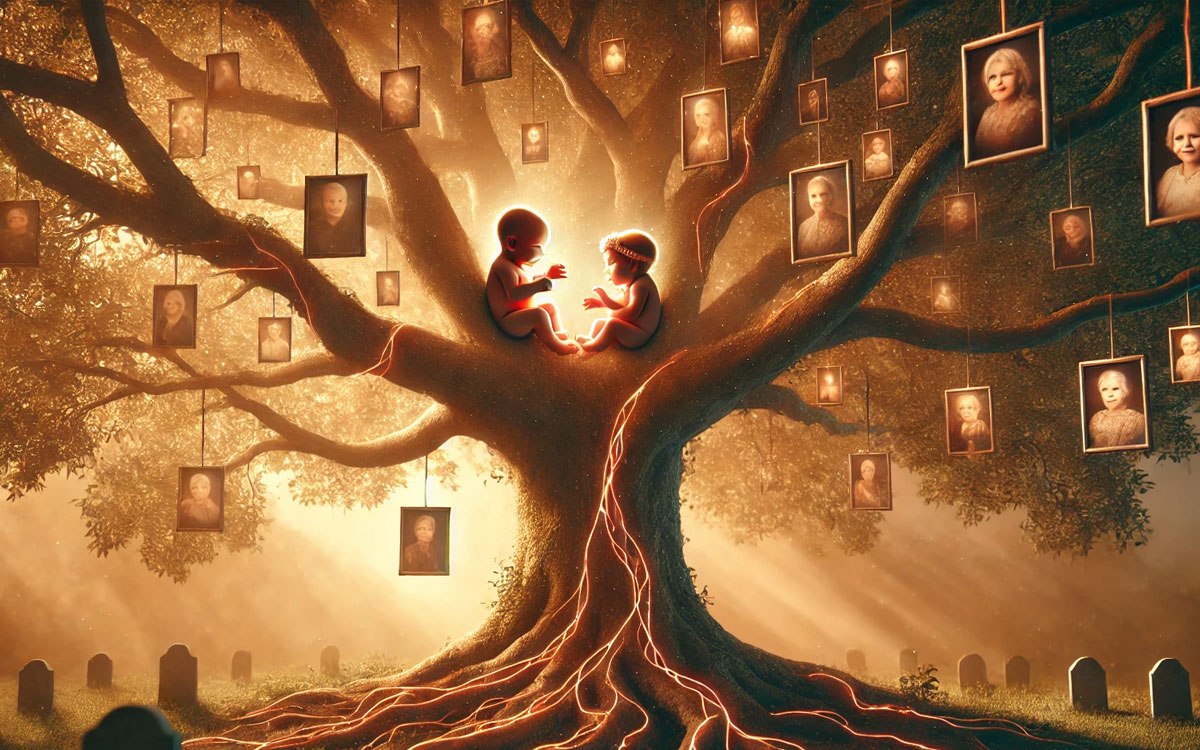
The detail in your family tree that explains the birth of fraternal twins
Factors that increase the probabilities
Beyond genetics, there are other factors that can also influence the likelihood of having twins or multiples:
- Mother's age: Women over 35 years old are more likely to release multiple eggs per cycle.
- Number of previous pregnancies: The more births a woman has had, the greater the chance of gestating fraternal twins.
- Diet rich in dairy and sweet potatoes: Studies have linked certain foods to an increase in multiple pregnancies, although the results are not conclusive.
- Ethnic origin: Some populations, such as those from West Africa, have higher rates of twins than others.
Identical twins: an unresolved mystery
Unlike fraternal twins, the birth of identical twins remains a mystery in many aspects. No specific gene has been identified that causes it, and it can happen to any couple, regardless of family history. That is why experts often describe them as a rare biological coincidence, but no less significant.
Could it repeat in new generations?
If you come from a family where fraternal twins have been born, you may wonder if that pattern could repeat with your children or grandchildren. The answer is yes, especially if the maternal line with a history of multiple ovulation is maintained. But in the case of identical twins, it remains more a matter of chance than inheritance.
The emotional and symbolic impact of multiple births
In many cultures, twins or multiples hold a special symbolic value. They are associated with double abundance, the balance of opposites, or even with spiritual gifts. Beyond the mystical, the truth is that in the family realm, their arrival can generate profound changes, redefine bonds, and reinforce the idea of connection between generations.