Dr. Maximiliano Alonso receives the Order of José Cecilio del Valle at the rank of "Commander"
The Mr. Alonso played a decisive role in the process of integrating Honduras into the Development Bank of Latin America and the Caribbean CAF.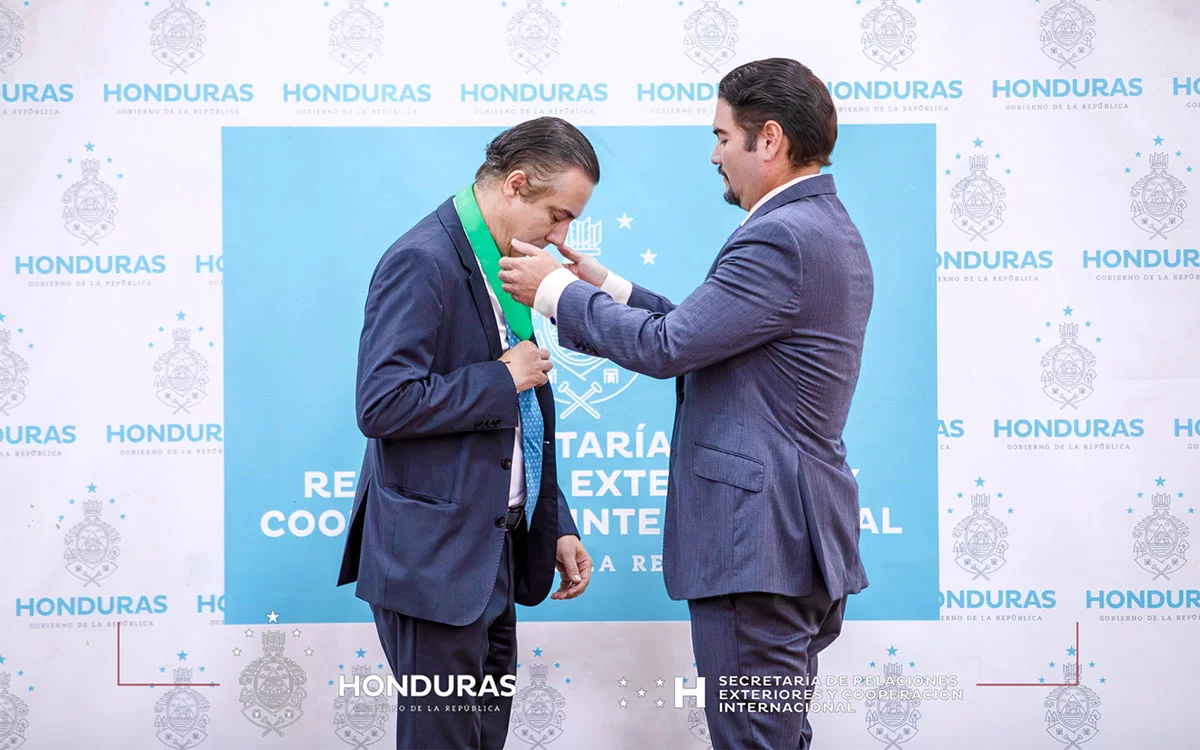
The morning light filtered through the windows of the living room seemed to caress more than illuminate. Outside, the bustle of Tegucigalpa continued its course; inside, silence became a pact.
The President of the Republic of Honduras, ministers, ambassadors, and international representatives took their places, while in the center of the scene awaited Dr. Maximiliano Alonso, Vice President of the CAF (Development Bank of Latin America and the Caribbean), with a contained voice and an open gaze.
At that moment, Alonso was about to receive the Order of José Cecilio del Valle at the rank of “Commander”. It was not, as he himself hurried to say, a personal recognition. “I feel it as a symbol of the special relationship that binds me to Honduras and its people,” he confessed, before emotion tempered his tone.
The history of that bond did not begin in times of calm.
The first time he set foot in the country, he arrived from Belgium, coordinating a European development project. It was the time after a coup d'état. “I spent almost ten days in a hotel, watching from a distance how a chapter of Honduran history was being written… and for me, it was not distant,” he recalled. In Argentina, his own family had known the weight of political instability and institutional violence. It was then that Honduras ceased to be a work destination for him and became an emotional geography.
Years later, his return was neither casual nor lukewarm.
Since his time at the Central American Bank for Economic Integration (CABEI) and then at the CAF, his efforts focused on projects aimed at changing concrete realities: infrastructure, clean energy, rural development, financial inclusion, education. “No one saves themselves alone,” he repeated as a mantra. “Equality, fraternity, and solidarity are not old ideas; they are urgent and essential values for building a fairer and more integrated Latin America.”
In his speech, the honoree also paused on an unexpected territory:
Technology and artificial intelligence. He did so without technical jargon, with the naturalness of someone who understands that advancements are not neutral. “We cannot confuse means with ends. Innovation must serve human dignity and the common good… that no one is left behind in the digital transition,” he warned, as if the fate of the region were also at stake in those words.
But not everything was projection towards the future.
There was room for warnings about the present: “We must not allow hatred, cruelty, and individualism to become fashionable… we would lose our reason for being: the certainty that we are with others, that we live in community.”
The echo of those phrases found a counterpoint in the words of José Cecilio del Valle, which the honoree made his own: “Men are free; men are equal before the law… No man is obliged to another man, except when he himself has chosen to oblige himself.” It was more than a historical quote: it was the thread connecting a visionary past and a present that demands firm commitments.
There were no shortages of thanks:
To the Government of Honduras; to the Ministry of Foreign Affairs and International Cooperation; to President Xiomara Castro; to the Chancellor and Vice Chancellor; to the CAF; to colleagues; to “duos” of work; and, with special tenderness, to his family. But the most intimate moment, although he did not say it in those words, was dedicated to the Hondurans: “Your warmth, resilience, and determination are an example for the entire region.”
The hall applauded for a long time. Outside, the day progressed. Inside, someone had just sealed a promise: “This recognition is not a destination point. It is a reminder that the commitment continues and that my heart, in some way, will always have a Honduran place.”
And one wondered if that was, in fact, the essence of all true distinction: not to reward what has been done, but to ignite the fire for what remains to be done.