This is the reason why Microsoft is back on top of the world.
Microsoft is once again the most valuable company in the world after stock market crashes driven by global trade tensions.
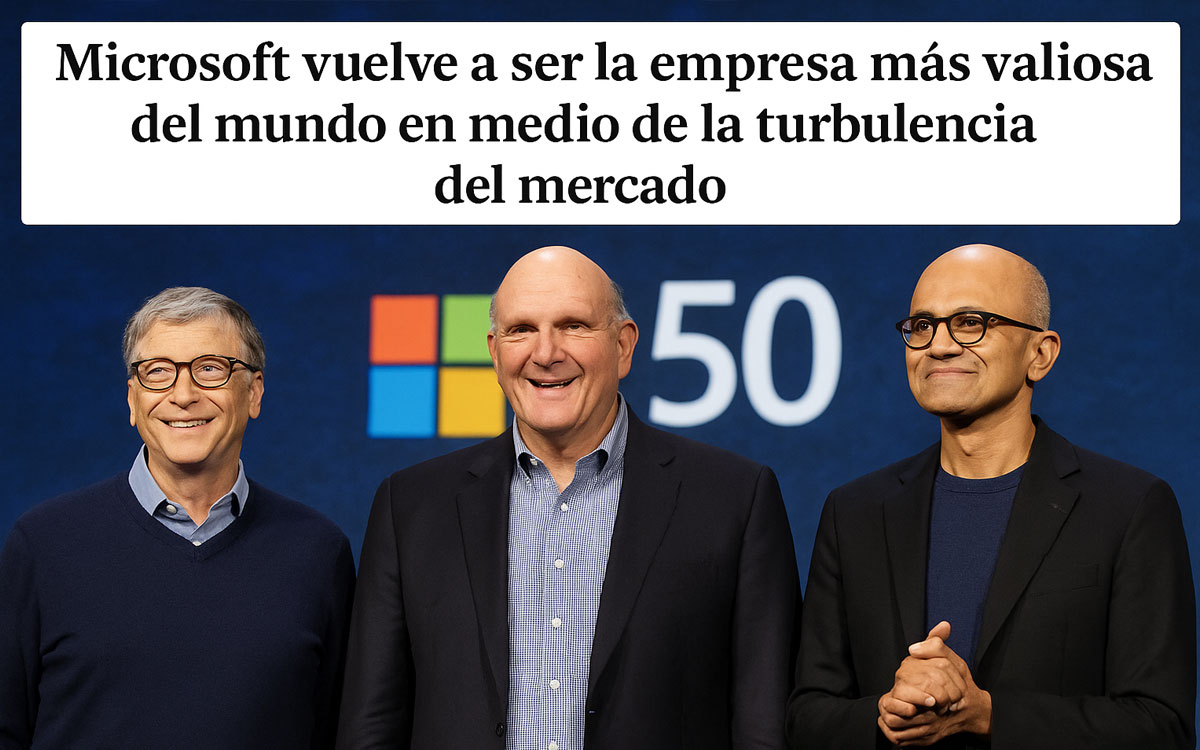
Microsoft is once again the most valuable company in the world following a sharp change in the dynamics of the global market. The company, founded in 1975 by Bill Gates and Paul Allen, has managed to reposition itself above Apple amid a strong stock market shakeup caused by political decisions that impacted the major tech companies on the planet.
Everything happened in a matter of days. Apple, which had regained the lead in market capitalization in June 2024, plummeted 23% in the value of its shares after former President Donald Trump announced new tariffs on imported products. The figure is striking: $773 billion evaporated from Apple's value. During the same period, Microsoft lost $200 billion, but managed to maintain its position better and climb back to the podium.
Microsoft: The return to the stock throne
Microsoft reached a market capitalization of $2.64 trillion, surpassing $2.59 trillion of Apple. This movement marks a new chapter in the rivalry between the two tech giants. Since 2023, both companies have been alternating leadership in market capitalization, reflecting their innovations and adaptability in an increasingly unstable economic context.
The news was confirmed on Tuesday afternoon when the markets closed. Despite a slight morning rebound, the trade blow announced by Trump ended up dragging down the entire tech sector, and Apple was the most affected.
A sector hit by politics
The tariff conflict driven by Trump included a 50% increase in tariffs on products from China, raising total duties to 104%. As a result, several companies in the group known as "The Magnificent Seven" —Apple, Amazon, Alphabet, Meta, Nvidia, Tesla, and Microsoft— recorded million-dollar losses.
Apple, particularly vulnerable, suffered a greater impact because a large part of its products are manufactured abroad. This global production structure, efficient in times of stability, becomes a weakness in times of trade tension.
Tesla also did not fare well. Its drop was 22%, very close to that of Apple. In contrast, Microsoft managed to limit its losses thanks to its more diversified business model focused on digital services and cloud computing.
Satya Nadella: the architect of resilience
The current president and CEO of Microsoft, Satya Nadella, has been instrumental in guiding the company during this phase. Since taking the helm in 2014, he has transformed Microsoft's focus, prioritizing cloud business, artificial intelligence, and enterprise services. This strategy has shielded the company from crises that affect other players more dependent on hardware or international manufacturing.
The recent event for the 50th anniversary of Microsoft brought together historical figures like Bill Gates and Steve Ballmer, along with Nadella, in Redmond. This commemoration served as a symbolic backdrop for the new stock milestone the company would achieve days later.
The cloud as a lifeline
According to financial data, most of Microsoft's revenue currently comes from software and cloud computing services, two areas less exposed to the turbulence of international trade. In contrast, Apple relies heavily on hardware sales, especially the iPhone, whose global supply chain is subject to tariffs and restrictions.
This explains why Microsoft fell less than other tech companies that also exceed $200 billion in market capitalization. Alphabet, Google's parent company, was another that held up relatively well, although it did not manage to surpass Microsoft in this situation.
Is a recession looming?
The climate of economic uncertainty has intensified following Trump's announcement. Several experts in the financial world have warned of a possible increase in inflation and the risk of a recession.
Jamie Dimon, CEO of JPMorgan Chase, mentioned in a letter to shareholders that the new tariffs “will likely increase inflation and are causing many to consider a higher probability of recession.” Meanwhile, Goldman Sachs raised its recession risk estimate from 35% to 45%.
Professor Philip Bond from the University of Washington added that this type of market movement is not random. “It is always tempting to think that the stock market moves randomly, but in reality, it tends to predict the future. The fact that it has dropped so much should be taken seriously.”
Impact on individual investors
Beyond the big names, the consequences are also felt in the pockets of ordinary citizens. Many American workers have investments in pension funds like the 401(k), which are heavily tied to tech stocks.
Bond emphasized this point: “Many people are exposed to this through their 401(k) accounts. I suppose this is especially true in Seattle, as high-income individuals are more likely to have one.”
The challenge ahead
The context presents a scenario in which tech companies will need to demonstrate their adaptability in the face of protectionist economic policies. Microsoft has emerged as the least affected, but the situation could change quickly if trade tensions escalate or if consumers reduce their spending on technology.
Meanwhile, Microsoft's achievement is not only financial but also symbolic. In an uncertain environment, its business model has proven robust, allowing it to return to the top of the global ranking.