The story of Francis of Assisi that forever changed the faith and now resonates after the death of Pope Francis.
The story of Saint Francis of Assisi takes on a new meaning after the passing of Pope Francis, who chose his name in honor of the saint.
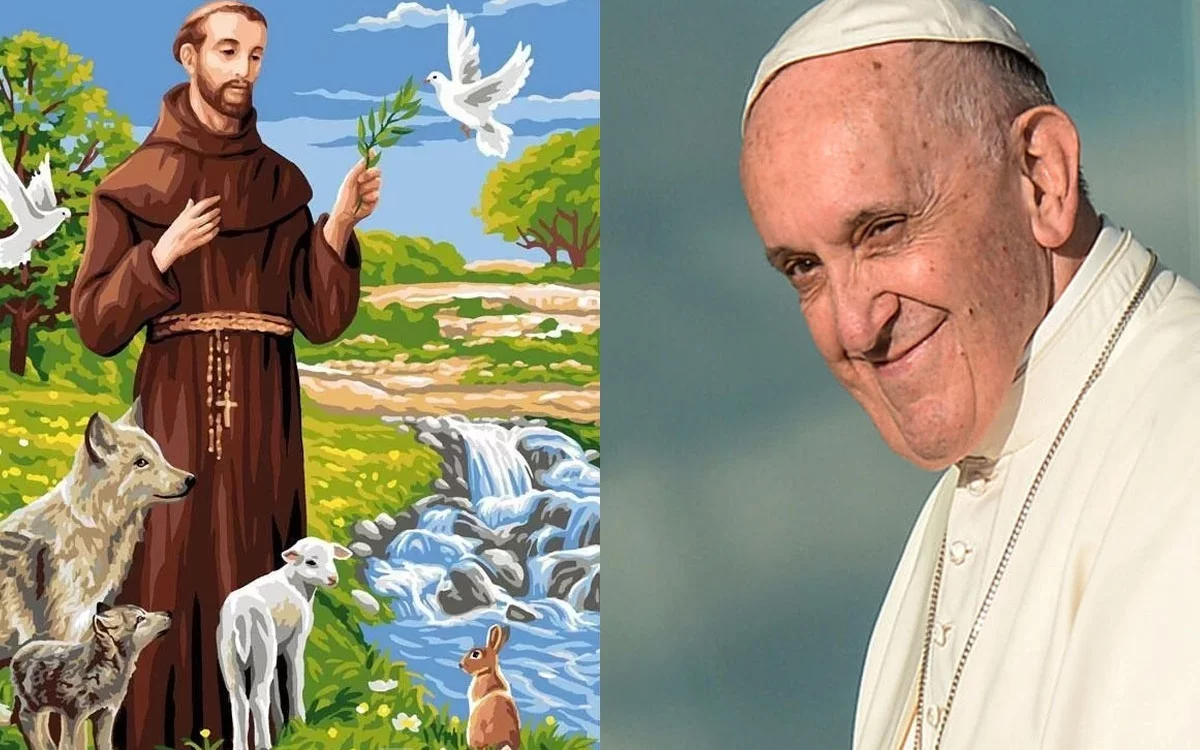
The story of Francis of Assisi has regained global relevance following the death of Pope Francis, the first Jesuit pontiff who, in an unprecedented gesture, chose his name in honor of the humble Italian saint. The life of Francis of Assisi, marked by renunciation of wealth and the radical pursuit of evangelical poverty, resonates today more powerfully than ever in a Church facing the challenge of returning to its roots.
A rich young man who renounced everything
Francis of Assisi, born as Giovanni di Pietro Bernardone in 1181 or 1182 in the prosperous Italian city of Assisi, was the son of a cloth merchant. During his youth, he led a comfortable and carefree life, characterized by luxury and parties. His family expected him to continue the family business, but his destiny took an unexpected turn.
According to chronicles of the time, a series of illnesses and experiences in war led Francis to deeply reflect on the purpose of his life. In an act that scandalized his surroundings, he publicly renounced his inheritance before the bishop of Assisi, declaring: "From now on, I will no longer say: My father Pietro Bernardone, but Our Father who art in heaven."
This episode marked the beginning of a life dedicated to living the Gospel literally, embracing poverty and serving the most needy.
The call of God before the crucifix of San Damiano
One of the most emblematic scenes of the story of Francis of Assisi occurred in the small ruined church of San Damiano. While praying, he heard the voice of Christ from the crucifix saying to him: "Francis, repair my church, which as you see, is in ruins."
Initially, he interpreted the message literally and began to rebuild temples in poor condition. Over time, he understood that his mission was much deeper: to revitalize a Church that, in his time, was mired in luxury and corruption.
The clarity of this vocation led Francis to preach a life of humility, love for nature, and universal brotherhood, concepts that were revolutionary for his time.
The foundation of the Franciscan order
In 1209, after gathering a small group of followers, Francis drafted a rule based strictly on the Gospels and traveled to Rome to seek the approval of Pope Innocent III. Although initially skeptical, the pontiff, according to historical accounts, had a dream in which he saw Francis holding up the Basilica of Saint John Lateran. This was interpreted as a divine sign, and the rule of the Franciscans received his blessing.
Thus was born the Order of Friars Minor, better known as the Franciscan Order. Its members dedicated themselves to itinerant preaching, manual labor, and assisting the poor, always living without personal possessions.
This radical lifestyle was considered scandalous by many, but it also inspired thousands of people seeking an authentic way to live Christianity.
An unconditional love for creation
Another distinctive feature of the story of Francis of Assisi is his profound love for all creation. He regarded animals, plants, the sun, the moon, and water as brothers and sisters. His famous "Canticle of the Creatures," also known as "Canticle of Brother Sun," is one of the earliest literary works in the Italian language and celebrates the beauty of the natural world as a reflection of divine love.
This ecological approach, ahead of its time, makes him the patron saint of modern ecologists. His vision of nature as an integral part of the divine plan resonates today in contemporary debates about the environment and sustainability.
The last stage of his life and his death
As his fame grew, so did tensions within his order. Many members wanted to soften the strict poverty that Francis had imposed. Disappointed but without losing faith, Francis withdrew to live in the solitude of La Verna, in Tuscany.
In 1224, he received the stigmata, the marks of the Passion of Christ, becoming the first known saint to experience this mystical phenomenon. He died on October 3, 1226, at the age of 44, singing psalms and lying on the bare ground, just as he had lived: without possessions.
He was canonized just two years after his death by Pope Gregory IX.
The eternal legacy of Francis of Assisi
The influence of Francis of Assisi has transcended the centuries. His message of love, humility, and respect for life continues to inspire believers and non-believers alike. His life has been the subject of numerous studies, works of art, and films.
Even world and religious leaders have evoked his figure to embody ideals of simplicity, compassion, and reform.
Pope Francis and the revival of the Franciscan spirit
When Jorge Mario Bergoglio was elected Pope in 2013, he surprised the world by choosing the name Francis, an unprecedented decision in the history of the Church. "I want a poor Church for the poor," he declared in his first words as pontiff, reflecting the spirit of the saint of Assisi.
The death of Pope Francis reignites reflection on his decision to identify with the "poverello" of Assisi. During his papacy, he promoted deep reforms in the Curia, denounced economic excesses, defended migrants, and placed the climate crisis at the center of Catholic teaching, perfectly in tune with Saint Francis's ecological sensitivity.
His encyclical "Laudato Si'," named after the Canticle of the Creatures, is an explicit tribute to this saint and an urgent call to care for the "common home" of the planet.
The death of Pope Francis not only closes a chapter in the Church but also reaffirms the relevance of the message of his spiritual patron: an invitation to live simply, love unconditionally, and protect creation.