"The Lion King": Javier Milei marks 1 year of government in Argentina and shows a positive management balance
Javier Milei celebrates a year of government: “We Argentinians have passed the test of fire.”

Javier Milei, the president who took office with a promise of radical change in Argentina, used a national broadcast to commemorate his first year in government. During his speech, he assured that the country has managed to emerge from the worst of the crisis and highlighted the advances in economic, institutional, and social matters. In an emphatic tone, he stated: “Happy times are coming in Argentina”, marking a milestone in his positive management assessment.
Since his arrival in power, Milei has pushed for structural reforms that, according to his vision, aim to eliminate the "system of privileges" that he considers responsible for decades of inequality and stagnation. These transformations range from reducing public spending to economic deregulation projects, a profound tax restructuring, and security policies aimed at toughening penalties against organized crime.
A message to Argentinians: “we have left the war behind”
In a speech filled with gratitude and reaffirmations, Milei began by highlighting those he considers the engine of change: “I want to especially thank the everyday Argentinians, those who were mistreated by the unjust model of the caste and who fight tirelessly day by day. Their sacrifice has been moving”.
For the president, the last year has been a “trial by fire” for the Argentine people, who, according to him, have demonstrated a unique capacity for resilience in the face of an adverse economic and social context. “We are coming out of the desert. The recession is over, and the country has finally begun to grow,” he stated, pointing out that although there is still a long way to go, the indicators show a significant improvement in economic stability.
Fall in inflation and projections for 2025
One of the main achievements highlighted by Milei was the fall in inflation, a structural problem that has plagued the country for decades. According to his analysis, the stabilization process initiated by his government has allowed for projections of a 2025 with low inflation, greater economic growth, and an increase in purchasing power.
“We are entering a new stage where Argentinians will be able to enjoy growing real wages, revalued pensions, and a more dynamic economy,” he noted. Among the main measures that contributed to these results, he highlighted the recomposition of business stocks and savings equivalent to 15 points of GDP, which, he said, will allow for an increase in both investment and consumption.
The tax reform that “will return autonomy to the provinces”
In one of the most ambitious announcements of his administration, Milei revealed that his team is finalizing a structural tax reform that will eliminate 90% of the current national taxes. “This change will allow us to return fiscal autonomy to the provinces that they should never have lost,” he emphasized.
The new tax structure aims to foster fiscal competition among provinces, with the goal of attracting investments and energizing regional economies. According to the president, this measure will put an end to the “fiscal suffocation” that has historically paralyzed the productive sector.
Advances in economic deregulation: bimonetarism and free trade
Another key focus of Milei's speech was his economic deregulation plan, which includes the progressive closure of the Central Bank and the implementation of a bimonetary system. “From now on, every Argentine will be able to conduct transactions in the currency they wish, whether in dollars, euros, or another currency. The only exception will be tax payments, which for now will continue to be in pesos,” he explained.
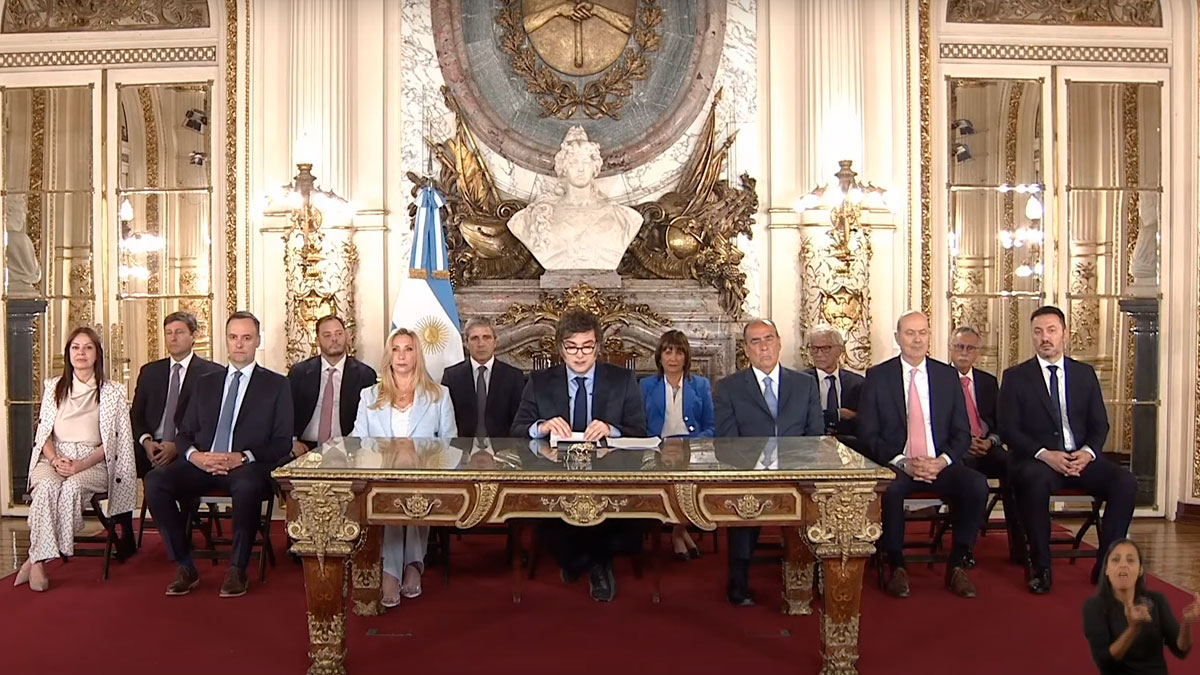
Javier Milei with the cabinet of ministers, during the speech assessing his first year in office in Argentina.
Regarding international trade, the president highlighted the progress toward a free trade agreement with the United States, which he described as “the agreement that should have been signed 19 years ago.” He also mentioned the need to reduce the common external tariff within Mercosur and eliminate non-tariff barriers that hinder economic integration.
“The deep chainsaw” and the shrinking of the State
With his already famous metaphor of the “chainsaw,” Milei reaffirmed his commitment to move toward a more efficient State, minimizing public spending as much as possible. “We have reversed the excesses of the last Kirchnerist years, but now comes the deep chainsaw,” he announced.
The plan includes the elimination of state agencies, secretariats, and public companies that he considers unnecessary, as well as a thorough audit to identify areas where spending can be further cut. “We want a State that is small, effective, and cheap for taxpayers,” he emphasized.
The time of the "common man" has come
"The privileged by the omnipresent State, who were increasingly more, became interested parties and defenders of the status quo. This explains why journalists, unions, social organizations, and politicians of all colors who until recently were at odds have united in defense of the status quo, as if they belonged to the same party, the party of the State. They want to live in their ivory tower in their fictitious paradise built on an increasingly impoverished society. They call their privileges acquired rights almost as if they were a kind of nobility with a divine right to live at the expense of society. Well, we came to dismantle that system from the roots. We came to end the regime of privileges that turned good Argentinians into second-class citizens. The time of the common man has come. That’s why we are passing the chainsaw to spending."
Security: anti-mafia laws and new federal agency
In terms of security, Milei proposed a series of reforms aimed at toughening penalties against repeat offenders and combating organized crime. Among the measures, he announced a new anti-mafia law inspired by the RICO Act in the United States, which allowed for the dismantling of criminal organizations in that country.
He also proposed the creation of an anti-narcoterrorism unit in the region of the triple border and the transformation of the Federal Police into a more modern and efficient criminal investigation agency.
“We want every criminal to be clear that in Argentina, those who commit crimes will pay for them,” he declared.
Nuclear plan and technology: a leap into the future
The president also surprised by announcing an Argentine nuclear plan that will include the construction of new reactors and research into emerging technologies for small or modular reactors. According to Milei, this strategy will position Argentina at the forefront of nuclear energy use, in a global context where energy demand is rapidly growing due to advancements such as artificial intelligence.
The reforms to come: labor, pension, and criminal
To conclude, Milei presented a roadmap with the reforms he will promote in the coming years. Among them, he mentioned a labor reform that will make hiring more flexible, a pension reform to ensure the sustainability of the retirement system, and a criminal reform aimed at toughening penalties for serious crimes.
He also announced a “profound political reform,” aimed at reducing the privileges of the ruling class and ensuring a more transparent and efficient system. “This is a train moving toward progress. You can get on or be run over by it,” he warned, reiterating his confidence that these measures will mark the beginning of a new era for the country.