The journey of milk: from the farm to your table in 7 revealing facts
Discover 7 curiosities about the process that milk goes through from the farm to each family's table.

Every June 1st, World Milk Day is celebrated, a date that often goes unnoticed on the calendar, but holds surprising stories about one of the most present foods in the daily lives of millions of people. Beyond the cup of coffee with milk, the glass at snack time, or the family recipe, milk is the result of a complex and meticulous process that begins on rural farms and ends on your table.
Argentina is a country with a strong dairy tradition. It produces around 12 billion liters of milk per year, according to data from the Argentine Dairy Chain Observatory (OCLA). Of that production, 80% is consumed in the domestic market, while the remaining 20% is exported. Despite its regular consumption — which reaches an average of 152.7 liters per person per year — few know what happens before the milk reaches the glass.
This World Milk Day is an opportunity to look at this essential food with new eyes, to understand how its quality is ensured, why it can be stored without refrigeration, and how its industry adapts to new logistical, technological, and environmental challenges.
1. From milking to analysis: controls that ensure purity
Everything begins in the field, in the farms where cows are milked under very controlled sanitary conditions. The process is not improvised or artisanal: it adheres to strict hygiene standards and productive efficiency. As soon as it is extracted, the milk is cooled to 4 °C to stop the proliferation of bacteria and is transported in refrigerated tanks to processing plants.
Once there, it undergoes a battery of laboratory analyses. Key parameters such as fat, protein, acidity, cryoscopy, and presence of antibiotics are verified. This ensures that the milk is safe before it undergoes thermal treatment and packaging. The FAO (Food and Agriculture Organization of the United Nations) highlights this process as one of the pillars for ensuring food safety.
2. Ultrapasteurization: heat for seconds, safety for months
One of the most decisive moments in the journey of milk is its thermal treatment. The most commonly used process for long-life products is UHT (Ultra High Temperature). It consists of heating the milk to about 135 °C for only 2 or 3 seconds, and then rapidly cooling it.
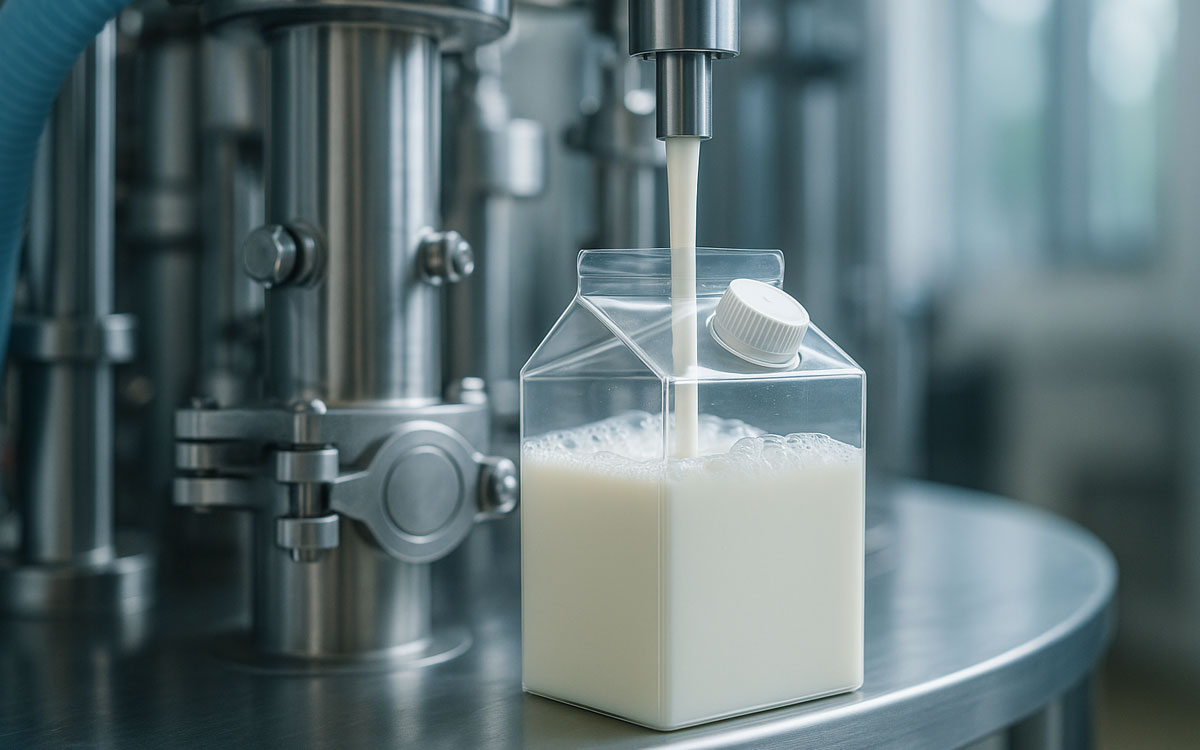
How milk is processed before reaching your table: 7 revealing facts
This thermal shock eliminates bacteria and microorganisms without affecting nutritional properties. The result is milk that does not require refrigeration while the package is closed, and can be stored for several months without losing quality.
3. Aseptic packaging: the invisible art of preventing contamination
After thermal treatment, every drop of milk enters a completely aseptic environment. This means that both the conduits and the packaging are sterilized to prevent any subsequent contamination.
Thanks to this technique, it is not necessary to add preservatives. The milk remains pure and safe, preserving its nutritional value without alterations. Additionally, this type of packaging allows it to be distributed in areas where access to refrigeration is limited.
4. A package with more science than it seems
Although it may seem like a simple carton, the packaging that protects UHT milk is a complex structure. Composed of several layers of cardboard, polyethylene, and aluminum, its design blocks the passage of light, air, and microorganisms.
This invisible shield preserves not only the flavor but also the nutritional integrity of the product. Technologies like those used by Tetra Pak allow each package to function as an effective barrier that extends shelf life without the need for added chemicals.
5. Preservation without refrigeration and with less environmental impact
One of the great achievements of UHT milk is that it can be stored and transported without a cold chain, significantly reducing energy consumption throughout the logistics.
This is not only useful for the industry and commerce, but also has a positive impact on the environment. Less refrigeration means lower carbon emissions. Additionally, multilayer packages are recyclable, contributing to a more sustainable consumption chain.
6. Reaching places where other foods do not
Sterile packaging has a clear social advantage: it allows milk to reach rural areas, schools, soup kitchens, and communities where electricity or refrigeration is intermittent or nonexistent.
Food assistance and child nutrition programs take advantage of this feature to distribute milk safely in remote locations. Thus, it becomes a key solution to combat malnutrition in vulnerable populations.
7. Technology that transforms everyday food
In a world where more and more foods require industrial processes, milk has managed to combine the best of both worlds: tradition and technology. Thanks to innovation in thermal processes, materials, and design, millions of people can access fresh and nutritious milk every day, without relying on refrigerators or complex distribution chains.
These advances not only represent a logistical triumph but also a direct benefit to public health. Maintaining constant access to an essential food like milk improves the overall nutritional quality of the population.
A new perspective for a timeless food
Milk is one of the most consumed foods on the planet, and yet, it remains one of the least understood. It has been present since childhood, but we rarely reflect on how it reaches our hands, nor on the number of people, controls, technologies, and sustainable decisions that intervene in that journey.
This World Milk Day is a perfect excuse to appreciate the entire production process, from milking to packaging. A process that ensures that each glass contains calcium, protein, and energy, but also history, science, and commitment.
In addition to being a source of essential nutrients — such as calcium, vitamin B12, and riboflavin — milk is versatile, accessible, and recommended for all ages. And while consumption in Argentina remains high, only 25% of the population knows the official recommendation: three servings of dairy per day.
Today, looking at a carton of milk with new eyes can help you understand how the food industry evolves and why these changes benefit not only consumers but also the environment and local economies.