The future of pistachios is in Argentina.
For more than 40 years, the Iranian Marcelo Ighani, owner of Pisté, has been cultivating pistachios south of San Juan, confirming, after years of research, the potential of those lands to develop an activity that promises to be one of the most profitable.
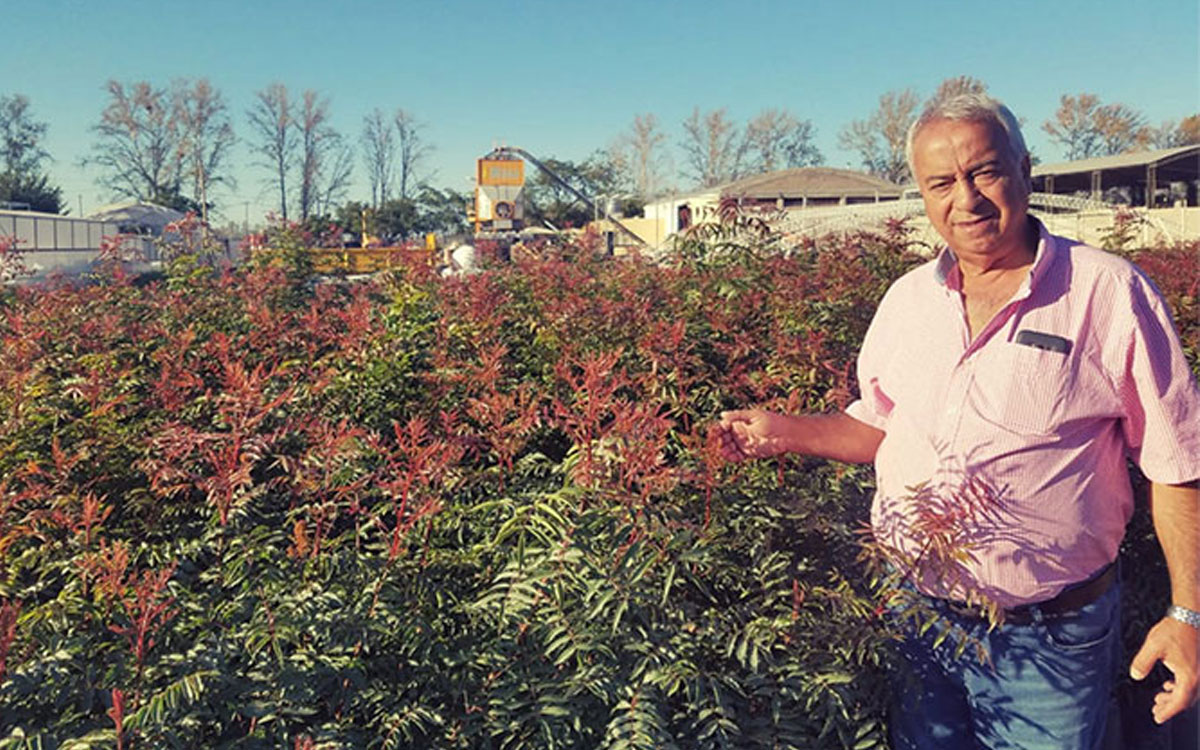
Source: www.expoagro.com.ar
In the last 5 years, the area dedicated to pistachio production in Argentina has grown by more than 500%, according to a report from INTA. San Juan is the province with the largest cultivated area in the country, occupying 6,500 hectares that represent 87% of the total, and this fact is not casual since in 1980 an exhaustive research work carried out by the Iranian Marcelo Ighani confirmed that the lands of southern San Juan, along with those of northern Mendoza, are the best for cultivating the so-called “green gold”.
From Iran to the land of the sun
Marcelo Ighani was the one who, with his business vision, a lot of patience, and a restless spirit, paved the way for pistachio production in the country. In 1969, at just 16 years old, he arrived in San Juan with his three brothers to study at the university, intending to return to Iran once he obtained his degree, but that would not be possible as the Revolution had begun in that area of the East in 1979. Once he graduated as an architect, he excelled with his construction company but, at the same time, began to venture into agriculture by helping his father-in-law, an important winemaker, with work in the vineyards. Seeing the complications in the sector, he began to think about what other crop could be more profitable. Thus, in 1981, when his exiled father traveled to seek refuge in Argentina, he had some pistachio seeds brought from Iran to investigate if this crop could adapt to the climate of San Juan, as it has similar characteristics.
In the mid-1990s, Marcelo traveled with two friends to California, another of the productive poles of the coveted dried fruit, to bring technology that would allow them to make the first plantings and set up a nursery. By 1998, Ighani planted the first farm, which is currently the oldest that is part of Pisté, the family business he formed to carry out his research and make the production and marketing of pistachio in Cuyo lands a reality. “This is the prime area for producing pistachio. Compared to the best areas in California, here we yield more kilos than they do with greater profitability,” he says in perfect Spanish but with an accent that still betrays his Iranian origin. To have the first production of one of the most sought-after dried fruits in the market, he had to wait six years. “The pistachio is something very good but over a long time,” he says with the satisfaction of having confirmed his intuition about the suitability of the lands for this crop. Among the characteristics that allow for a quality export product are the climate, water depth, soil quality, and chilling hours. The pistachio withstands low temperatures and tolerates salinity.
The pistachio legacy
Currently, Marcelo continues to participate in the company, but those in charge are his daughter Soledad, responsible for administration and the nursery, and his son Maximiliano, who specialized in Arizona in managing the entire production chain.
The pistachio tree of a productive plantation can reach up to 8 meters and in full production can yield an average of 15 kilos of fruit per year. Although it can be active for 80 to 100 years, the prior process to achieve these results is extensive: “First, the soil must be prepared, it is advisable to do it between August and December, keeping in mind that the pistachio has a very developed and deep root system, so it prefers light soils. The planting is done, with a drip irrigation system, and one waits 5 to 6 years for the plant to enter production, as long as the climate cooperates and no mistakes occur that delay the process. The harvest is between February and March,” explains Maximiliano.
Furthermore, Ighani's successor states that the formative pruning done every winter is key. “This pruning is linked to the mechanical harvest that will take place approximately five years later, so if it is not done correctly, there will be major problems for the harvest,” he says.
Sharing experience to continue growing
As a pioneer, Marcelo is a great reference for all those who want to start in this crop, which is why he does not hesitate to share his knowledge and experience, with his successes and mistakes, so that the activity continues to grow. “Everything we do, we share, even though we have 150,000 hectares, there is still a need for a pole to produce 10 million kilos, for that reason we speak with open hearts to everyone so they can produce,” he states. Today in Argentina, there are only five pistachio producers, so “there is still much to do and learn.”
A demonstration of his generosity is the Nursery, a space where 250,000 certified seeds germinate per year, brought from Arizona, which can be purchased by future producers. “We sell a UCB1 variety plant, which is grafted with buds from our plantations that are Kerman (female) and Peters (male) varieties,” shares Maximiliano. He also comments: “As advisors, we emphasize making good decisions from the start, which is why we support new producers with information and visits to our farm so they can learn from our mistakes.”
Recently, INTA, after systematizing a decade of meteorological data and phenological information about pistachio, presented a map with the first agroclimatic zoning of this crop. From this report, it emerges that the south of San Juan and north of Mendoza, along with the south of San Luis and central-south La Pampa, have been added as suitable lands for this production. However, Maximiliano clarifies that “one thing is zoning and another is promising profitability. While in the case of La Pampa the climate analysis is comparative to that of San Juan, they are not the same, which is why they are within the range, but to know what the yield will be, one must wait 10 to 15 years, even then it will only be possible to know if a differential pistachio is obtained.” In this regard, Marcelo emphasizes the importance of “caring for our entrepreneurs, so they do not invest in a place that does not yield results” and believes that “it is very premature to talk about new lands that are suitable because it takes five years to start producing and five years to follow up”.
According to producers, the cost of producing a kilo of pistachio from planting to harvest and industrialization is around $1.50 per kilo, while the selling price for industrialized pistachio ranges from $10 to $11 per kilo, an international price that is imposed due to the scarcity of suitable lands. The only places that meet the necessary conditions to develop this market are the Middle East, California, Australia, and Argentina, which opens hope that “in 20 years we can position ourselves as the third-largest pistachio producer in the world,” as the Ighani predict. However, to achieve this, work must begin with long-term results in mind.