The dream of the butterfly: when an ancient metaphor forces you to rethink everything
The dream of the butterfly questions reality, identity, and our consciousness like never before you imagined.
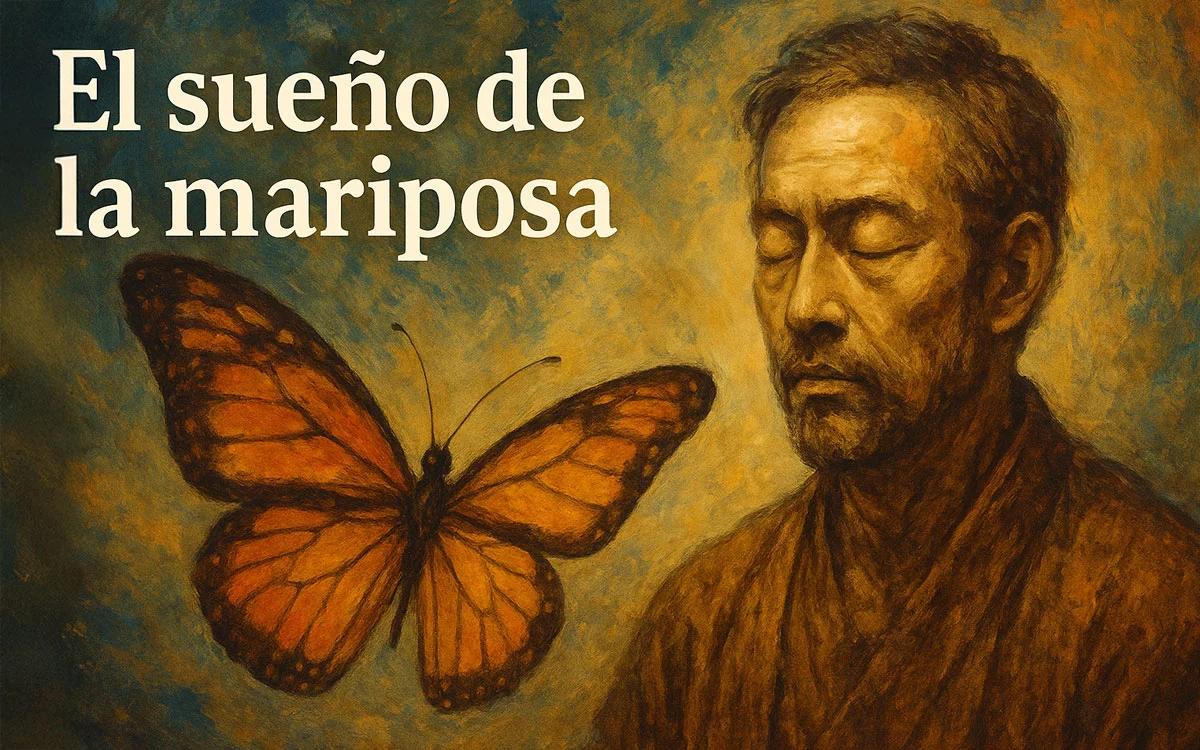
What if your reality were nothing more than a dream? The butterfly dream, an ancient metaphor born from Taoist thought, questions our most basic certainties. Attributed to the Chinese philosopher Zhuangzi, this brief tale has survived for over 2,000 years and continues to challenge those who dare to listen to it attentively. In a world where the virtual, the dreamlike, and the intangible intertwine more each day, its message seems more relevant than ever.
The brief tale that shook centuries of thought
More than two millennia ago, the wise Zhuangzi wrote these lines that, over time, would become one of the most famous enigmas of Eastern philosophy:
“Once Zhuangzi dreamed that he was a butterfly, fluttering happily, not knowing that he was Zhuangzi.
He awoke and realized that he was Zhuangzi.
But then he no longer knew if he was Zhuangzi who had dreamed of being a butterfly,
or a butterfly now dreaming of being Zhuangzi.”
This passage, as simple as it is unsettling, opens a range of philosophical, spiritual, and psychological questions that continue to resonate with those who read it.
When dreaming and living become confused
The illusion of the real
The butterfly dream is, above all, an intellectual provocation. How can we be sure that what we experience is true? What if everything we perceive is merely an illusion, a projection of something we cannot fully comprehend? This doubt is not exclusive to Taoism. It has also been central in movements like existentialism, in authors like Descartes (“I think, therefore I am”) or even in modern stories like Matrix.
Today, in an era where digital environments blur with physical ones and virtual avatars occupy our time, this questioning becomes even more relevant.
Identity as a fleeting reflection
Are we really who we believe we are? Zhuangzi seems to suggest otherwise. Perhaps there is no fixed "self", but multiple versions of ourselves, changing like a dream. This challenges a deeply rooted notion in the West: that of a permanent identity. Instead, from the Eastern perspective, identity is fluid, like water or wind.
This has inspired many modern psychologists, especially those studying states of consciousness or ego dissociation. In therapeutic contexts, this perspective can even help release tensions linked to “should be” or rigid self-image patterns.
Unity with the universe
From the Taoist viewpoint, there is no essential separation between human beings and nature. What Zhuangzi experiences when dreaming he is a butterfly is not confusion, but revelation: he and the butterfly are part of the same universal flow. Instead of asking what differentiates us, this tale invites us to see what unites us.
This directly connects with contemporary ecological, spiritual, and philosophical principles that promote a more integrated view of the world. It is no longer about dominating nature, but understanding that we are nature.
The fragility of knowledge
The tale also raises a critique of knowledge as something absolute. If we can dream with as much intensity as we live, how reliable are our perceptions? This epistemological relativism is an open door to intellectual humility, to accept that what we know might be just a tiny part of a much vaster reality.
Current interpretations that continue to grow
In psychology: the mind as creator of realities
For modern psychology, this tale can be read as a metaphor for the subconscious. What we dream is no less real than what we live, at least from the perspective of our emotions, which are equally intense in both realms. Thus, the butterfly dream reminds us that the mind constructs internal realities that profoundly influence our well-being and our decisions.
In art and literature: boundaries dissolve
Many artists have used this metaphor to explore the boundary between fiction and reality. In novels, paintings, films, and even video games, the dilemma of “what is real?” has become a powerful narrative resource. This not only challenges the viewer but also makes them a protagonist in the questioning.
In spirituality: a call to awaken
For many contemporary spiritual movements, this tale represents an inner awakening. It is not about stopping dreaming, but about awakening within the dream. Understanding that what we call “life” is part of a greater mystery can lead us to live with more presence, more gratitude, and less attachment.
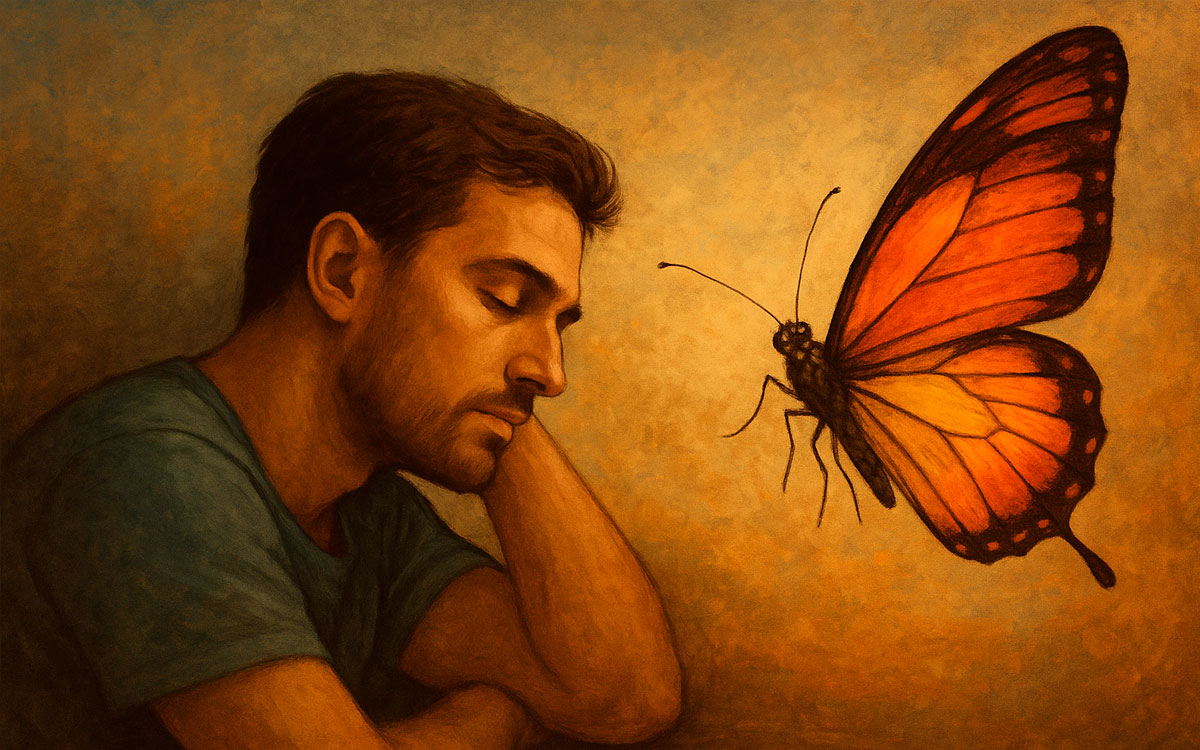
Is what you live real? The message of the butterfly dream
Practical applications for your day-to-day
The butterfly dream is not just a philosophical exercise. It can become a powerful tool for self-knowledge if you know how to apply it:
1. Question your certainties.
How many of your beliefs have you adopted without analyzing them? Stop and observe: perhaps many come from habits, education, or fear, not from understanding.
2. Accept that identity changes.
You are not the same person you were a year ago. Nor will you be the same in another year. Allowing yourself to change is accepting your human nature.
3. Observe without judging.
Practice mindfulness. Learn to look at life with the curiosity of one who knows that they do not know everything. This opens doors to new possibilities.
4. Connect with the essential.
Walk barefoot, breathe deeply, look at the sky. The Tao, the natural flow of the universe, is in those small moments.
5. Live as if you were both: Zhuangzi and the butterfly.
The dilemma does not need an answer. Wisdom lies in living fully, knowing that this may be a dream… or not.
The mystery remains relevant
Today, the butterfly dream confronts us with a simple yet transformative truth: nothing is as solid as it seems. And perhaps, by accepting it, we can live with more freedom. The final question is not “what is reality?”, but “what are you doing with it while it lasts?”
And you, are you the one dreaming or the dream itself?