The day we stopped googling
We are experiencing an irreversible change in how we seek information. Artificial intelligence marked the point of no return.
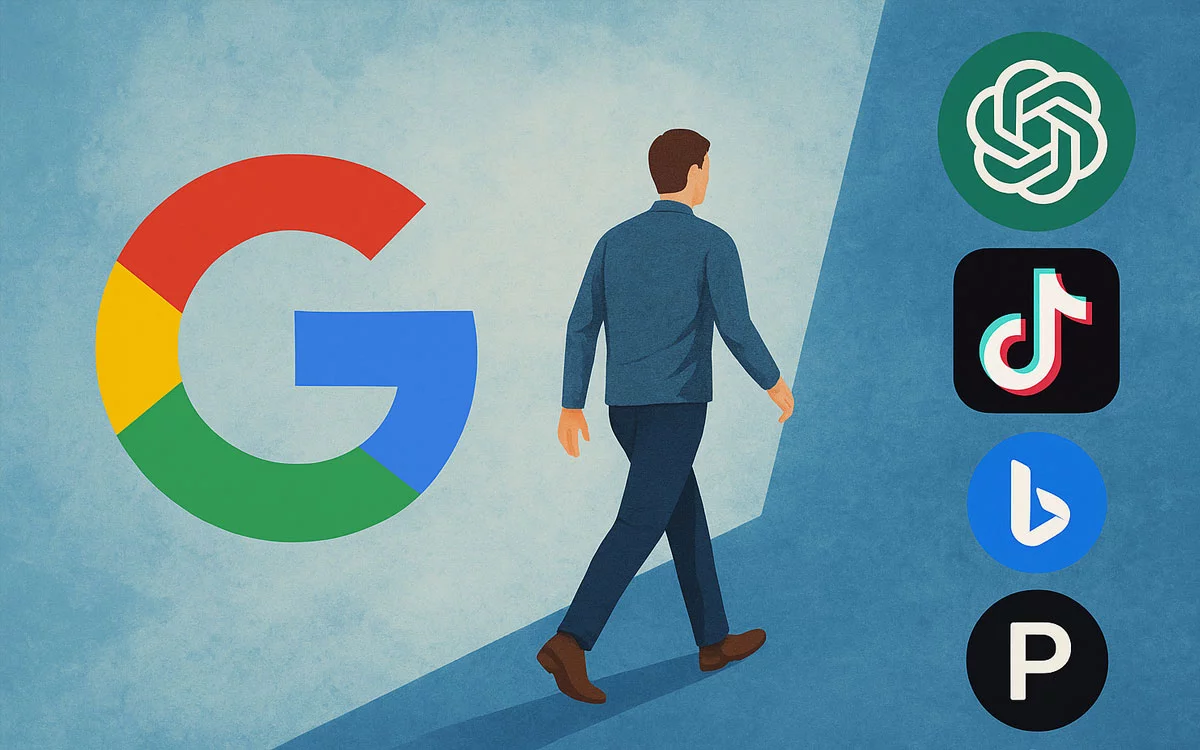
The day we stopped googling marked the beginning of a new digital era
The day we stopped googling was not simply a curious anecdote in the history of the internet. It was the most evident symptom that something deeper was changing. That automatic, everyday, and universal gesture of opening Google to search for anything began to fade. In its place, a new habit emerged: asking a direct question to an artificial intelligence. The hegemony of the most powerful search engine on the planet began to crack in March 2025, when its global market share fell to 89.7%.
This number, which still seems dominant to many, represented a crack in a wall that appeared impenetrable. For Google, it was not just a loss of users: it was the beginning of an existential crisis. And the culprit was none other than artificial intelligence.

For more than two decades, googling was as automatic as turning on the light. Today, that action is being replaced by a direct conversation with AI systems that do not offer links, but answers. The paradigm shift is already underway, and those who do not adapt risk being relegated to the margins of the new internet.
A hegemony that is no longer undisputed
Google dominated the digital world without real competition for years. Its search engine was the starting point for millions of users every day. However, in March 2025, a break occurred: for the first time since the early 2000s, its market share fell below 90%.
The most shocking data is in searches conducted from computers: there, Google barely retains 79.1%. What is at stake is not just a portion of the market, but the control of the global flow of information.
People have begun to abandon results filled with links. They prefer clear, direct, and uninterrupted answers. And AI systems like ChatGPT are leading this transformation. With over 800 million monthly users, they are not competing with Google… they are rewriting the rules of the game.
Searches are no longer searches: they are conversations
The way we interact with information has changed. It is no longer about typing keywords and clicking through ten links. Now it is about asking a question in natural language, receiving an answer, and if necessary, delving deeper with a second or third question, without leaving the conversation.
Platforms like ChatGPT —with 3.9 billion monthly visits—, Bing Copilot, Perplexity, TikTok, and Instagram are altering the way we consume information. It’s not that people have stopped searching. It’s that they now do it in completely different places and formats.
Younger generations are leading this silent revolution. Instead of opening Google, they open TikTok. They search for videos. They explore visual content. They converse with virtual assistants. Everything, except using a traditional search engine.
From searching to conversing: artificial intelligence becomes your ally
The key to the new ecosystem is not just the responsiveness of AI, but personalization. AIs learn from each interaction, better understand our intentions, remember our interests, and provide more refined answers.
According to recent data, 80% of users manage to resolve at least 40% of their informational needs directly with artificial intelligence. Queries in natural language have skyrocketed, revealing a cultural transformation, not just a technological one.
AI does not offer sponsored links. It does not filter results based on the highest-paying advertiser. It provides clean answers. And that, in a world saturated with advertising, is pure gold.
SEO no longer rules: now AEO does
Traditional SEO —Search Engine Optimization— has lost weight against the new paradigm: AEO, or Answer Engine Optimization. It no longer matters as much that your content appears on the first page of Google. What matters is that an AI uses it as a reliable source of information.
What’s the new goal? To be cited, not just to be visited.
To achieve this, it is now necessary:
Structured and updated content,
clear answers to frequently asked questions,
and authority in the sector.
AI platforms scan trusted sources and select those that meet quality, timeliness, and credibility criteria. If your content meets those standards, AI will position you at the top… without the need for clicks.
Having a website is no longer enough: you need multichannel presence
Having a website today is like having a business card. It’s good to have one, but it’s not enough.
The new ecosystem demands being present on multiple channels, simultaneously and with different strategies. Audiences are dispersed. And content must adapt to each format and platform.
Some of the key spaces are:
- Visual networks like TikTok and Instagram, where young people no longer just entertain themselves, but also inform themselves.
- Closed communities like Telegram or Discord, where trust, community, and value are built.
- APIs connected to AI engines, like those used by ChatGPT or Perplexity, which feed their responses with real-time data.
In this scenario, being on Google no longer guarantees visibility. What matters is being where the attention is.
What’s coming: the next big technological wave
The near future promises more disruption. Experts estimate that traditional searches could decrease by up to 25% more by 2026. Google, for its part, is already working against the clock to integrate AI into each of its services.
There is also speculation about the entry of new players. Apple could launch its own search engine with integrated AI. If realized, this move could cause a new earthquake in the digital landscape.
Searches related to health, science, and finance could migrate to specialized platforms with advanced AI. This new internet will be fragmented but hyper-personalized. Each user will have an informational environment tailored to their needs, interests, and lifestyle.
Are we ready for a world without Google as the axis?
The answer is: we are already living in it.
What seemed unthinkable —the day we stopped googling— has already happened. And what’s coming is not a crisis. It’s an opportunity.
Artificial intelligence will not replace our way of searching. It is redesigning it.
And if you know how to adapt, you will not only not be left behind… you will get ahead.