Neither the medieval scribes nor the merchants of the Renaissance… the symbol that ultimately conquered the digital world.
Where does the @ symbol come from? And why is it used in email addresses? Below, we present a logical and complete explanation of its origin and evolution. Its history is more fascinating than you might imagine.

The unexpected journey of the symbol @: from medieval manuscripts to the heart of the digital age
The symbol @, known in Spanish as arroba, is now ubiquitous in every email address and on social media. But what few imagine is that this very modern character has medieval roots and a history that spans centuries of cultural, commercial, and technological evolution.
Arroba: Arabic origin and use as a measure
The word arroba comes from the Hispano-Arabic ruba, which means “fourth part,” derived from the classical Arabic arba, meaning “four.” In its beginnings, this word had nothing to do with the digital realm. Instead, it referred to a unit of weight used in Spain, equivalent to a fourth of a quintal, that is, 11.502 kilograms.
For centuries, the arroba was used to measure agricultural products and goods, especially in markets of the Spanish-speaking world. In that context, the use of the symbol @ was not yet widespread, but the connection between the measure and the graphic character that represented it was already in gestation.
From Latin to commerce: an abbreviation with centuries of history
Long before the advent of the Internet, medieval scribes were already using the symbol @ as an abbreviation for the Latin preposition ad, which can mean “to,” “toward,” “in,” “for,” or “against.”
This abbreviated use was particularly relevant in manuscripts, where saving space and time was essential. However, its fate could have changed radically with the advent of the printing press. Unlike other signs that disappeared with modern typography, the symbol @ survived thanks to Renaissance merchants.
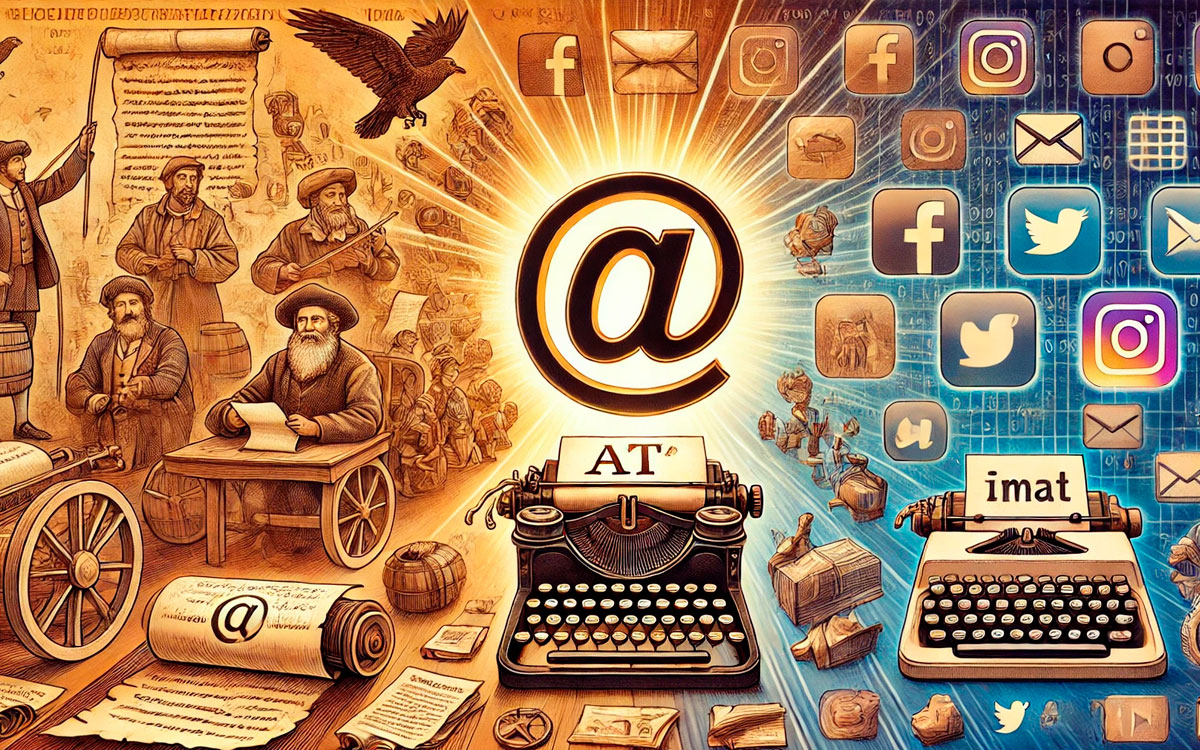
@Arroba@: the journey of a medieval symbol to the heart of the digital age
In written commercial transactions, it was common to see notations like 12 @ 3L, which were interpreted as 12 units at 3 pounds each. This formula became so common in invoices and records that the symbol found a new life, now as an accounting tool.
The mistake that named it "arroba"
The use of the symbol @ as a synonym for “arroba” was not originally intentional. According to Professor Salesi Porta, an expert in Logic and Artificial Intelligence at the Polytechnic University of Catalonia, it all began with a confusion in the port records of the 19th century in Catalonia.
In these documents, formulas like 50 @ 100 duros were used, where the initial number represented the quantity of units, followed by the price per unit. As it was not specified which unit was being used, it was assumed to be a measure of weight, and since the arroba was the most common, the definitive association between the symbol and the unit of measure was established.
Thus, what began as a Latin abbreviation, and was later adopted by merchants, ended up being incorrectly identified as an arroba, consolidating the name we use today.
Salvation through the keyboard
By the late 19th century, when the first typewriters were being designed in the United States, engineers decided to include the symbol @ on the keyboard. The main reason was its utility in commercial contexts, especially for drafting invoices.
Interestingly, many of the keys that were included in those machines were inherited unquestioningly by modern computer keyboards, including the symbol @. This seemingly minor decision would be key to its later integration into the structure of email.
Ray Tomlinson and the choice that changed digital history
The turning point occurred in 1971, when engineer Ray Tomlinson, a pioneer of computing, developed the first email system between networked computers. He needed a character that could separate the user's name from the server's name.
As Tomlinson himself explained, the symbol @ was rarely used in common language, making it perfect for this function. Additionally, its historical meaning as “at” or “to” fit naturally with the concept of email. Thus, an address like name@server.com could be interpreted as “the user at the server.”
It was a pragmatic decision that, however, marked a before and after in digital communication. Since then, the symbol @ has become a universal standard in the architecture of email.
The digital renaissance of the symbol
What Ray Tomlinson started in the 70s had global consequences. From the 90s, with the explosion of email use, the symbol @ began to be part of the daily life of millions of people around the world.

Ray Tomlinson and the unusual origin of the arroba: from medieval markets to Silicon Valley
And with the rise of social media, its role gained even more strength. Platforms like Twitter turned it into a tool for identifying users and directing messages, consolidating its presence as an essential symbol of digital identity.
Today, it is not only present in emails and social media but also in registration forms, databases, labels, programming commands, and messaging platforms.
The hidden history behind a modern icon
Few people know that the symbol we type almost without thinking on our devices hides a story of over a thousand years. From its origin in Latin manuscripts, through the hands of merchants, accountants, and telegraphers, to the technical decisions of a visionary programmer, the symbol @ has been rescued time and again from oblivion.
Thanks to a mix of necessity, confusion, functionality, and opportunity, it ended up becoming one of the most influential characters of the 21st century.
The journey of the symbol @ is a fascinating example of how the evolution of language, technology, and culture can converge in unexpected ways, transforming what was once a simple medieval shortcut into a key piece of modern communication.