Mar del Plata: they present a labor and educational program to reduce criminal recidivism
In the Batán Penitentiary Unit, the company B Cook Master is carrying out an initiative to provide work, training, and support to incarcerated individuals and those released.
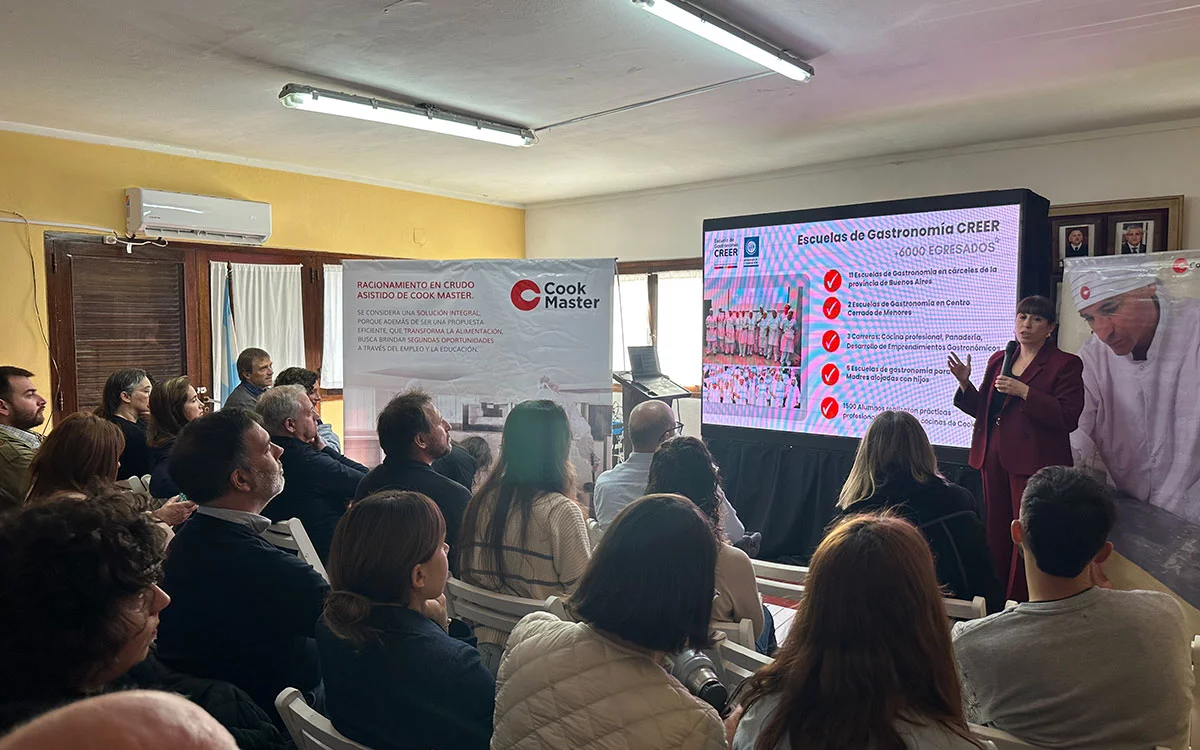
As part of the visit of the B Impact Circle to Mar del Plata, 40 representatives from local and national companies visited the Batán Penitentiary, where the Creer Program was presented. This program aims to promote the social reintegration of individuals deprived of their liberty and those released through education and work, while also strengthening the economic development of the local community and security.
The B Company Cook Master has just joined the Batán Penitentiary as a provider of gastronomic services, inaugurating a new kitchen-school there. The company develops the Creer Program in 20 prisons across the country, which now arrives in Mar del Plata. This initiative provides work, training, and support to individuals deprived of their liberty and those released, so they can acquire a trade with high demand in the current job market.
“When we started the project, I was told it was impossible. Today we feed 25,000 people in the penitentiary service and work inside the prisons to improve the lives of those who are there,” explained Nicolás Lusardi, Founder and CEO of Cook Master. “We do this through education, offering training in hard and soft skills so they can reintegrate into society later.”
The kitchen-schools of Cook Master, located in different penitentiary units across the country, such as Florencio Varela and La Plata, have already graduated 6,000 individuals since the program began in 2017. “The recidivism rate is close to 60%, and the recidivism rate within the program is 3%,” added Samanta Sacaba, Sustainability and Corporate Affairs Leader at Cook Master.
In addition to prison facilities, the company provides gastronomic services to other types of organizations and hires released individuals or young people whose parents are detained, as well as other groups facing employability barriers. They are also part of the Creer Network, which coordinates the work of 50 public, private, and third-sector organizations to generate formal job opportunities for released individuals.
Marina Arias, Executive Director of Sistema B Argentina, highlighted this example of public-private collaboration to provide solutions, as well as the social role of the company. “We no longer have to think in transactional terms, but in how we work together. Also from academia, we need more professionals who understand companies as social actors, and all of us, from our role as consumers,” she said. The NGO leader also announced that they are working on an impact purchasing project to boost the local ecosystem, which will be announced soon.
“Sistema B showed us that we could be a better company for the world, not the best company in the world. It provided us with a framework and a methodology to develop our impact business model, with measurement tools, methods, and a network, which helped us sustain over time and scale. Today this idea is being replicated in other countries, such as Paraguay and Uruguay,” concluded Lusardi.
The presentation of the case took place during a meeting of the B Impact Circle in Mar del Plata. This business community seeks to promote Triple Impact (economic, social, and environmental) in the country and visited the city along with authorities from Sistema B Argentina to share integration, leadership, and support spaces with representatives from local companies.
“This is a city that is transforming in an ecosystemic way. There are large companies on this path and many entrepreneurs who are born with this logic, in addition to a public sector and an academia that are increasingly committed,” said Déborah Sabsay, founder of the Mar del Plata B Companies Lucenza and Kalmar Distillery. “One can only reach a point with individual logic, but the impact of a network is enormous,” she concluded.
From the Circle, Ricardo Minicucci from B Company TRASA; Fernanda Mierez, Co-chair of Sistema B Argentina and partner at Beccar Varela law firm; Laura Busnelli from B Company Buplasa; Marcelo Mattio from Urbano; Sebastián Peluso from B Company Limpiolux; Julián Alegre from B Company Gire; Ana Guerello from B Company Danone; Margarita May from Isolant; Nicolás Lusardi from B Company Cook Master; Martín Jersonsky from B Company Ecofactory; and Guillermo Pugliese from B Company PSA traveled to Mar del Plata:
The B Impact Circle, promoted by Sistema B Argentina, is made up of representatives from large companies, both with and without B Certification, committed to being a bridge between the traditional economy and a new economy that seeks to place the well-being of people and the planet at the center of its decisions.
B Companies: profitability with purpose
B Companies are verified by the nonprofit organization B Lab for meeting high standards of social, environmental, and transparency performance. They have 3 main characteristics: they define a purpose; they modify their statutes to protect it and legally commit to benefiting not only shareholders but all stakeholders of the company (such as workers, customers, communities, and the environment); and they measure and manage their impact in a process of continuous improvement.
In Argentina, there are more than 260 B Companies from 30 different industries and sectors. In the city of Mar del Plata, there are 5 Certified B Companies: Lucenza, Kalmar, Lulea, CEDEAC, and Sarasanegro. Globally, the number rises to 9,788 in 105 countries around the world.