Days on Earth could last 25 hours: this is the phenomenon explained by scientists.
An inevitable change? A study reveals a phenomenon that will change the Earth forever.
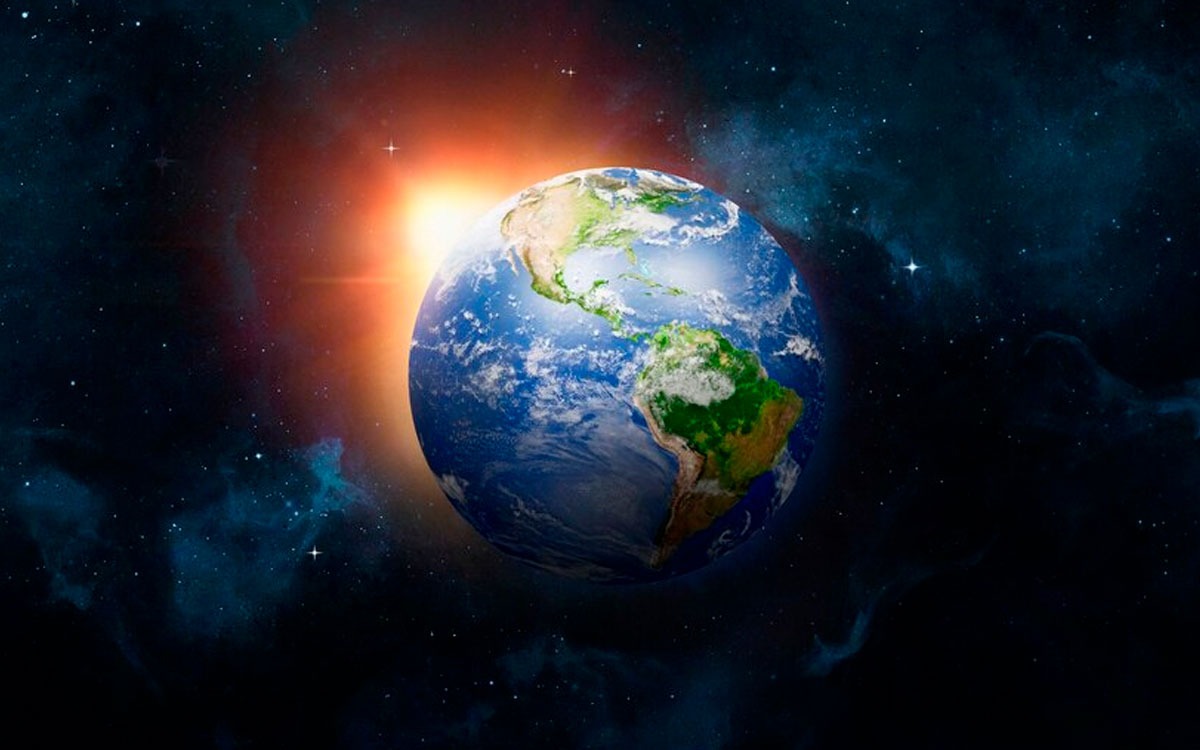
A recent study from the Technical University of Munich (TUM) has revealed a phenomenon that could transform life on Earth as we know it. Days, which currently last 24 hours, could extend to 25 hours due to changes in the planet's rotation. Although this impact would be gradual, its long-term implications could reconfigure fundamental aspects of our existence.
Why will days have 25 hours?
The change in the duration of days is directly related to modifications in the rotation of the Earth. According to scientists at TUM, the planet experiences an almost imperceptible alteration in its movement due to gravitational forces and internal phenomena.
The study revealed that the planet's internal movements, along with its gravitational interaction with the Moon and other celestial bodies, generate a deceleration in rotation. This phenomenon, although subtle, accumulates over time. According to observations, the Earth is gradually moving away from the Sun, which also contributes to these modifications.

How did they discover this phenomenon?
To measure the alterations in the Earth's rotation, researchers used an advanced ring laser at the Wettzell Geodetic Observatory. This device is capable of detecting extremely small variations in the planet's rotation speed.
Over a period of two weeks, specialists recorded a modification of six milliseconds in the duration of the day. Although this variation may seem insignificant, in astronomical terms it is a relevant data point that, if maintained, could extend days to reach 25 hours in the distant future.
What implications would a 25-hour day have?
The possible effects of this phenomenon would not only be limited to the astronomical realm but could also profoundly impact human life, climate, and science. Among the affected areas, the following stand out:
- Biological rhythms: Circadian cycles, which regulate biological functions in living beings, could be altered due to the extension of light and dark hours.
- Meteorology and climate: Current climate models may require significant adjustments to adapt to the new patterns.
- Astronomy: Astronomical tools and calculations would need to be recalibrated to account for changes in Earth's rotation.
Some experts believe that the change could bring advantages, such as greater adaptation of the human body to daily demands, while others warn of possible complications for natural ecosystems.
A look into the past: the duration of days over time
The duration of days on Earth was not always 24 hours. According to scientific records, 1.5 billion years ago, days lasted approximately 19 hours. During the Jurassic era, days had lengthened to 23 hours, marking a steady pace of deceleration in rotation.
This demonstrates that changes in the duration of days are part of a natural and continuous process in the evolution of the planet, although their direct impact on living beings depends on the speed and magnitude of the change.
When will this phenomenon occur?
Despite how surprising this prediction is, scientists estimate that this change will not be immediate. The process could extend over 200 million years, providing enough time for humanity, if it still exists, to adapt to the new conditions.
This finding also highlights the capacity of science to understand phenomena on time scales that exceed human life, prompting reflection on the impact of our actions on a constantly evolving planet.