Aphrodite: the goddess of love, beauty, and desire
The goddess of love and beauty: secrets of Aphrodite and her immortal stories in Greek mythology. The power of love and passion that shaped gods and humans.

Aphrodite is one of the most iconic figures in Greek mythology, known as the goddess of love, beauty, pleasure, and fertility. Her presence in the collective imagination stands out not only for her power of seduction but also for the intricate myths surrounding her origin, her relationships, and her influence over gods and mortals. Throughout the centuries, Aphrodite has symbolized the overwhelming force of love and desire, but also the tensions that these can generate.
Who was Aphrodite according to mythology?
Aphrodite belongs to the Olympic pantheon, a group of deities that ruled from Mount Olympus. Although she is primarily recognized as the goddess of beauty and love, her figure represents much more than the superficial: she embodies the power of attraction and passion, capable of shaping the destinies of both gods and humans.
According to classical sources, Aphrodite is also associated with fertility, prosperity, and sexuality, attributes that make her a fundamental goddess in Greek mythology. Her influence encompassed not only the romantic or erotic but also the role of beauty and love in the creation of life.
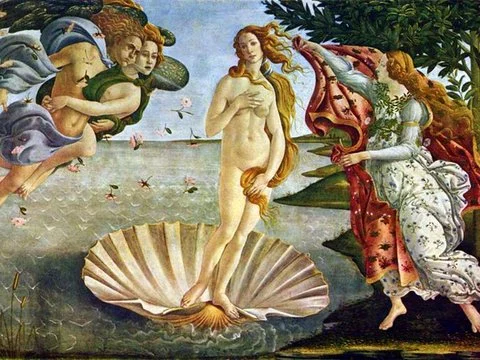
How was Aphrodite born? Two versions of her origin
Greek mythology offers two main accounts of Aphrodite's origin, depending on the sources consulted:
- The Hesiod version: According to Theogony by Hesiod, Aphrodite was born in a unique and almost cosmic way. Cronus, the titan, castrated his father Uranus and threw his genitals into the sea. From the foam (in Greek, aphros) that formed on the waves, Aphrodite emerged, fully formed and exceptionally beautiful. This version connects her with the primordial forces of the universe, granting her a nature older than that of the other Olympic gods.
- The Homeric version: In The Iliad, Homer presents Aphrodite as the daughter of Zeus and Dione, a minor goddess. This account gives her a more conventional origin and integrates her more directly into the Olympic hierarchy.
Both versions agree on one key aspect: Aphrodite was conceived as an irresistible force, whose power influenced all living beings.
Why is her myth important?
The myth of Aphrodite is essential in Greek mythology because it addresses universal themes: love, desire, beauty, jealousy, and conflict. Her figure transcends the worship of a goddess to become a reflection on human emotions and the dynamics they generate.
Aphrodite is not just a goddess who inspires love; her myth also highlights the conflicts that arise from her passions and whims. Her story touches on aspects of great emotional complexity, ranging from lust and betrayal to the destructive power of jealousy.
Notable myths of Aphrodite
1. The marriage to Hephaestus
Despite being the goddess of beauty and love, Aphrodite was married to Hephaestus, the god of forge, known for his ugliness and limp. This marriage, arranged by Zeus, was never happy, as Aphrodite maintained numerous lovers, among whom Ares, the god of war, stands out. Her relationship with Ares symbolizes the contrast between love and conflict, but also her irresistible attraction even towards feared deities.
2. The judgment of Paris
One of the most famous myths involving Aphrodite is the judgment of Paris, an event that sparked the Trojan War. When Eris, the goddess of discord, threw a golden apple inscribed "For the fairest," Aphrodite, Hera, and Athena competed for the title. Paris, a Trojan prince, was chosen as the judge, and Aphrodite bribed him by promising him the love of the most beautiful woman in the world: Helen of Sparta. His choice not only highlighted her power over men but also the disastrous consequences of unrestrained desire.
3. Aphrodite and Adonis
The myth of Aphrodite and Adonis is one of the most tragic and emotional stories in Greek mythology. Aphrodite fell in love with the young Adonis, whose beauty was extraordinary. However, their love ended in tragedy when Adonis died after being attacked by a boar. This myth reflects Aphrodite's connection to mortality and pain, showing that even the goddess of love is not exempt from suffering losses.
4. Pygmalion and Aphrodite
In another myth, Aphrodite plays the role of a benevolent goddess. Pygmalion, a sculptor who found no satisfaction in women, created an ivory statue of an ideal woman and fell deeply in love with his work. Seeing the intensity of his love, Aphrodite granted his wish: she brought the statue to life, known as Galatea. This myth underscores Aphrodite's power to transform passion and idealization into reality.
Aphrodite and her influence on culture
The impact of Aphrodite transcends Greek mythology. In Roman mythology, she was identified as Venus, retaining her main attributes. Her cult was widely popular and adopted by different cultures, symbolizing the importance of love and beauty in the human experience.
Furthermore, Aphrodite has influenced art, literature, and philosophy throughout the centuries. Paintings, sculptures, and poems have represented her figure and her myths, from the Venus de Milo to Botticelli's famous painting The Birth of Venus.
Why is her myth still relevant?
The myth of Aphrodite remains relevant because it addresses themes that continue to be fundamental to humanity. Love and desire, beauty and its impact, emotional conflicts, and the consequences of our decisions are timeless issues. Moreover, Aphrodite personifies the duality of love: its ability to inspire happiness and its potential to cause chaos and suffering.
Ultimately, Aphrodite is not just a symbol of superficial love; she represents the complexity of human emotions and how they can shape our lives and our relationships.