After this move, the God of Science never played another game of chess.
In the center, at a large table, a game of chess was being played, the opponents were the God of Science and the God of Intuition...
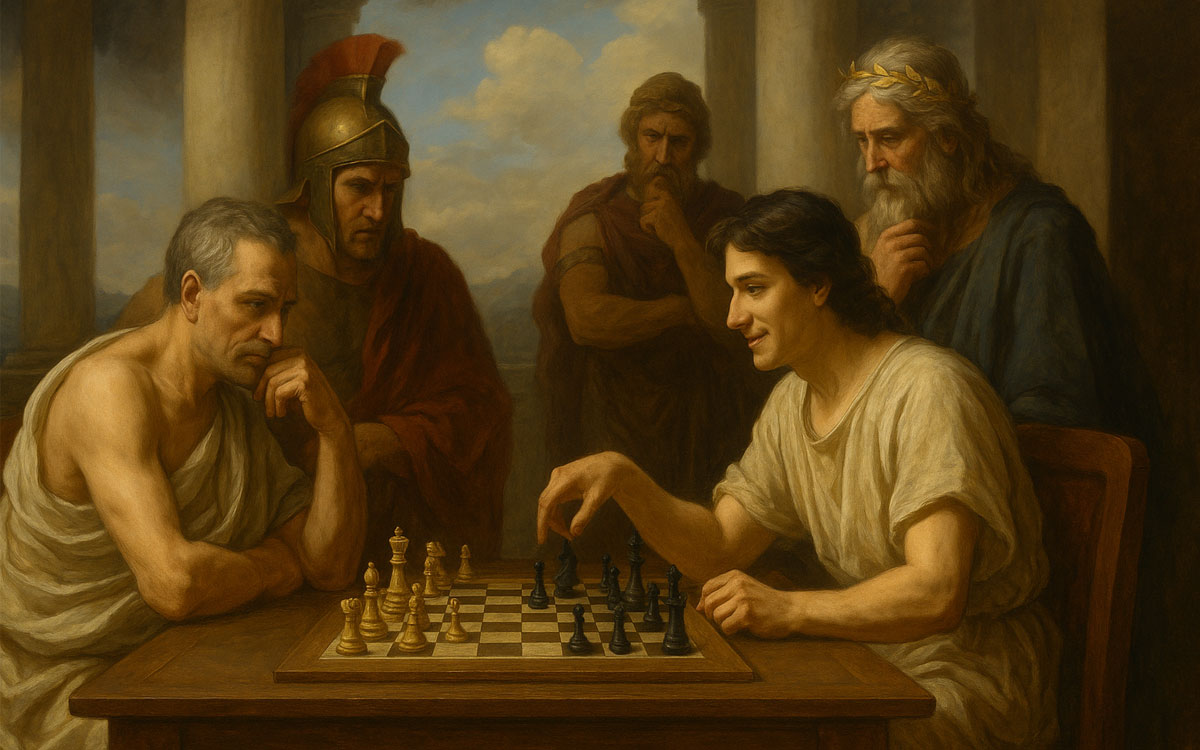
A game of chess in Olympus was not something common, nor predictable by any means. That afternoon, the gods had set aside their celestial occupations to gather around a large table. In the center, on a perfectly carved board, two opposing forces faced off: the God of Science and the God of Intuition. The air was solemn, but deep down everyone knew that this contest went beyond the simple game: it was a reflection of the eternal conflict between logic and instinct.
The other gods watched in silence, occasionally interrupted by some joking comment or an ironic laugh. The tension, however, was palpable with every move. From the first exchange of pieces, the game became a conceptual battlefield: reason against premonition, calculation against emotion.
"It's your turn," said the God of Science in a firm voice. He had devised a meticulous strategy. His mind reviewed possible moves, probabilities, patterns. Science, after all, leaves no room for improvisation.

"Check," replied the God of Intuition calmly. His queen moved decisively. The attack was direct, clean. His calm gaze contrasted with the surprised expression of his opponent. The king was in danger, and the scientific mind of the god could not find the perfect move to escape the predicament. It was as if all his knowledge crashed against an invisible wall.
The God of Wisdom, who had remained silent until then, watched him attentively. He saw in his eyes the growing anxiety, the desperation of not understanding why all his knowledge was insufficient against such an unexpected rival.
Then, the God of Politics intervened.
"Use a trick," he suggested. "Make him believe you will do one thing and then do the opposite."
The advice appealed to strategic deception, to manipulation. The God of Science followed it without questioning. He moved a piece cunningly. The deception was effective.
"Check," he announced, satisfied.
But the smile lasted little. The God of Intuition responded quickly and fluidly. His next move put the king in check again. There was no respite. The scientist's face tightened. He could not understand how that young man —because the God of Intuition was the youngest in Olympus— could surpass him so easily.
The God of War spoke up:
"Attack from the flank. Wear him down. Make him lose strength."
The God of Science followed the strategy precisely. He resorted to a direct, forceful attack. The board trembled under the violence of his moves.
"Check," he said again, believing he had gained ground.
But no. Once again, the God of Intuition responded calmly, with that barely perceptible smile that disarmed any pretense of victory. The scientist was starting to become bewildered. How was it possible?
Then the God of Technique intervened.
"Technically, the only option is to castle the king," he said.
The God of Science, obedient to logic, executed the castling. He felt secure after applying the best technical move available.
"Check," his opponent replied again.
The board seemed to mock him. He had exhausted all formulas, all algorithms, all political, military, and technical strategies. He was alone, and he did not understand why. Then his gaze sought another option. He saw the God of Wisdom, who looked at him with serene compassion.
"What can I do?" he finally asked, defeated by confusion.
"Why don't you ask him?" replied the wise one, pointing to the God of Intuition.
"He's my opponent," he retorted. "And very young, by the way."
"Only he knows the answer," said the wise one. "Sometimes the solution lies in the one we least expect. Perhaps age makes us lose our instinct."
The God of Science decided to take that step. He looked at the young man with humility and asked:
"What should I do?"
The God of Intuition looked him straight in the eyes and replied:
"When you learn to read in the eyes of others from your heart, then you will find the solution."
The mind of the God of Science tried to reason the phrase. He broke down each word, analyzed it, related it to theories of perception, language, and neuroscience. But he did not understand.
"I don't understand what you mean," he admitted.
"Don't try to understand," said the young man. "Just listen to your heart."
"The heart doesn't speak; it's just a muscle," the scientist retorted.
It was then that the God of Wisdom spoke in a grave voice.
"On Earth, there exists a race that believes animals are our incarnations. They say that human beings have lost the ability to listen to their totemic animal. That is, to their spirit…".
"That's superstition," interrupted the God of Science. "It makes no sense. It is not scientifically proven."
"We agree," echoed the God of Technique, the God of Politics, and the God of War.
The God of Wisdom lowered his gaze. His eyes reflected sadness.
"You will never change. You believe yourselves above everything. But the only way to learn is to position oneself beneath everything. Like the valley, which receives the waters from the mountains because it is precisely beneath them."
The God of Science shrugged. “All that sounds nice, but it won't help me win the game.”
"If you seek to win so much," said the wise one, "then you have already lost."
The phrase resonated in Olympus like a sentence.
The God of Science fell silent. The young man before him raised his gaze, moved his piece with precision, and pronounced the final phrase:
"Checkmate."
The board remained still. The spectators fell silent. None of the great strategists, warriors, or technicians had managed to reverse that game. The triumph had been that of the youngest God. The one who did not calculate, but felt.
And in that victory lay a lesson that few were willing to accept: that sometimes the answer is not in the reasoning mind, but in the listening heart.