What does the Holy Trinity really mean and why is it present in science, religion, and human consciousness?
Neither only religion nor only science: this is how the Holy Trinity and the meaning of the pattern that repeats in everything is understood today.
The Holy Trinity is one of the most complex and profound concepts in both theology and modern spiritual thought. From the Christian tradition to quantum physics, and from philosophy to psychology, the idea of a “unity composed of three aspects” is repeatedly emphasized, as if it were part of the essential pattern of reality.
A fragment from Conversations with God by author Neale Donald Walsch offers an unconventional interpretation of the Trinity. Departing from traditional religious dogmas, the text proposes a vision that unites knowledge, experience, and being as three interconnected dimensions of the evolution of consciousness.
Trinity as a process of evolution: knowing, experiencing, and being
At the core of this proposal is the idea that knowledge alone is not enough. It is a high state, yes, but incomplete without experience. Experience is what transforms knowledge into embodied wisdom. And being, as the final stage, is the synthesis of both: it is the fullness that emerges after knowing and living.
This sequence —knowledge, experience, being— is what Walsch defines as the true Holy Trinity.
- God the Father represents knowledge: the source of all understanding.
- God the Son symbolizes experience: the embodiment of what knowledge contains.
- God the Holy Spirit is being: the state that results when experience is integrated with knowledge.
From this perspective, God is not just the creator: He is also the created, and what is once the process of creation and understanding has been completed. In other words, it is an eternal cycle of self-knowledge, manifestation, and unity.
Beyond religion: the Trinity in other disciplines
What makes this approach remarkable is how it resonates beyond the religious realm. The so-called “Trine Truth” appears in various forms across multiple systems of thought.
In psychology, for example, Freud identified three dimensions of the psyche: the id (drives), the ego (consciousness), and the superego (internalized norms). Other more modern models propose the interaction between subconscious, conscious, and superconscious.
In contemporary spirituality, many currents work with the triad body, mind, and spirit as the three essential dimensions of the human being.
In physics, the basic forms of the universe are grouped into energy, matter, and ether (although the ether as a concept has evolved, the idea of a third intermediate substance remains present in field theories and dark energy).
In philosophy of language and action, it is considered that a truth does not fully manifest until it exists in thought, word, and deed.
Even in the structure of everyday reality, we recognize this pattern of three: past, present, and future; here, there, and the space in between; before, now, and after.
Why is the Trinity a constant?
The text suggests that the ordinary relationships we use to describe the world are generally binary: cold-hot, big-small, fast-slow. These dyads allow us to compare, choose, and locate. But they are limited. There is no accepted “in-between” within them.
In contrast, higher-order relationships —those that deal with time, being, consciousness, and God— are triads. And in them, the “intermediate” is not a neutral point, but an essential element that completes and sustains the whole.
For example, there is no present without past or future. There is no being without knowing or experiencing. There is no Holy Spirit without the Son or the Father.
The Holy Trinity, in this sense, is not a division of God, but a way of understanding the divine totality in motion, in relation to itself. It is the God who knows, experiences, and then simply is.
The Trinity and time: past, present, and future as a single flow
One of the most disruptive concepts in Walsch's fragment is the idea that time, as we conceive it, is an illusion of the human mind. From theoretical physics and modern cosmology, it is argued that the past, present, and future coexist in what is known as the “block space-time.”
Similarly, Walsch explains that in the realm of the sublime —that deep level of being— there are no opposites, only progressions. Time is not linear, but cyclical and interdependent. Just as scientists describe quantum simultaneity or entanglement, in this elevated plane everything happens at the same time: knowing, experiencing, and being are not separate stages, but different expressions of the same expanding consciousness.
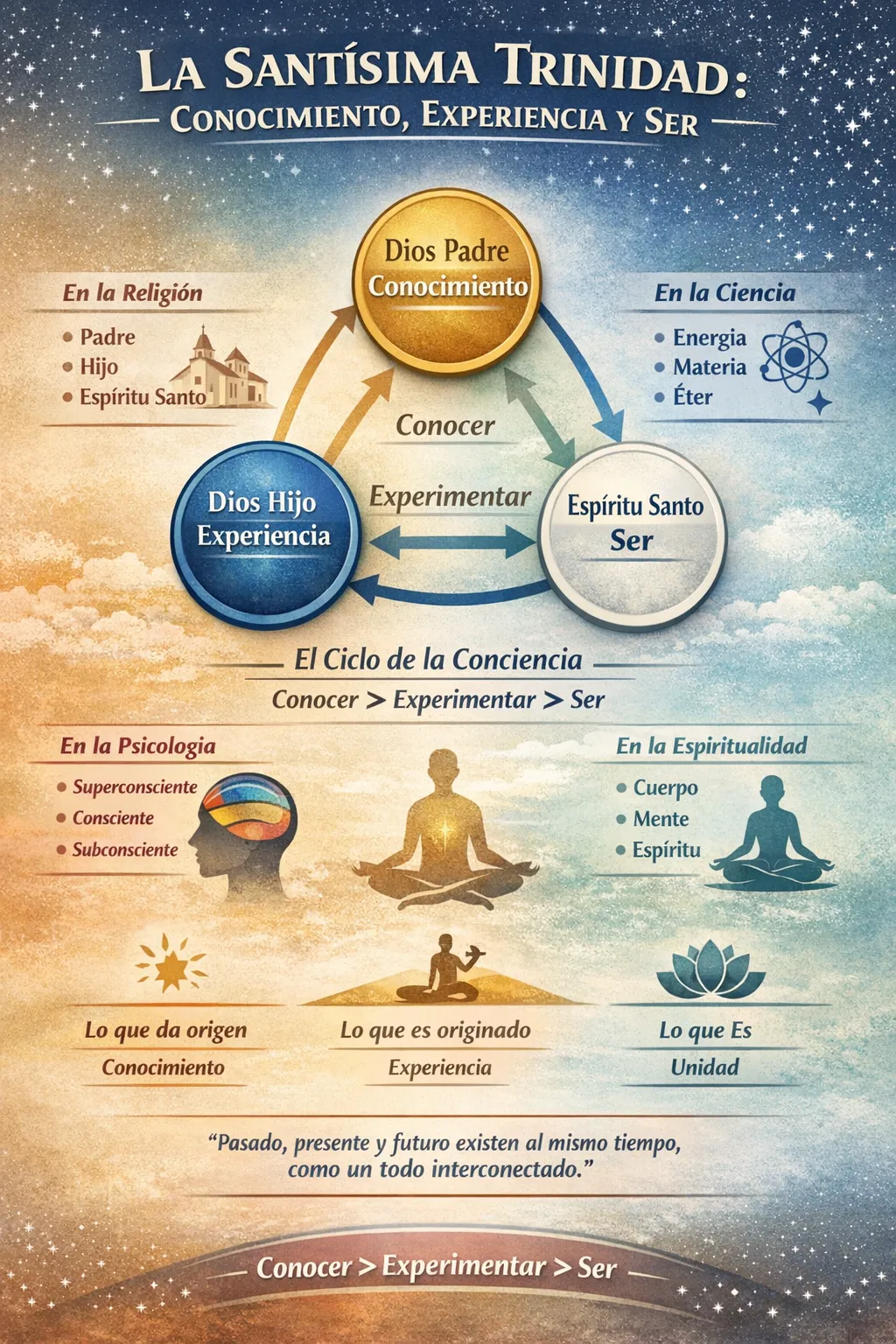
The Trinity as a model of unity: what gives origin, what is originated, what is
The text proposes a reinterpretation of the Father, the Son, and the Holy Spirit, not from the language of patriarchal religion, but from a functional approach:
- What gives origin (knowledge, intention, the spark).
- What is originated (experience, manifestation, the act).
- What is (integration, memory, the state of being).
This sequence resonates with multiple traditions, from Hindu mysticism (Brahma, Vishnu, Shiva) to alchemy (solve, coagula, integrate), or even Jungian psychology, which proposes that true growth occurs when opposites are integrated in a third symbolic space.
What implications does this idea have for everyday life?
If everything in the universe evolves through knowing, experiencing, and being, then personal growth also follows this path:
- Knowing something does not mean you fully understand it.
- Experiencing it allows you to live it firsthand.
- Becoming that is the final step: you no longer think about it or do it, you simply are it.
This can be applied to love, compassion, forgiveness, patience, any virtue. It is not enough to understand it intellectually. Nor to have practiced it once. Only when it becomes part of your identity —when you simply are compassionate, effortlessly— have you completed the circle of the Trinity.
An invitation to contemplate the whole
Walsch's vision does not seek to impose a dogma, but to offer a comprehensible and universal metaphor to address the mystery of being, time, consciousness, and God. And in that attempt, it finds echoes in all the great traditions of wisdom.
The Holy Trinity, then, is not just a Christian theological mystery, but an archetypal pattern that runs through the deepest structures of reality. It is in time, in space, in thought, in biology, in the soul.
Understanding it is not an act of faith, but of conscious observation.
Because everything that transforms does so in this way: by knowing, experiencing, and being.
And perhaps, that is the path that divinity itself chose to recognize itself.