The 6 mistakes you make when sitting that explain your neck and back pain
The pain in the neck and back increases with the use of screens. There are simple postures and habits that can relieve it before it becomes chronic.

Neck and back pain has become one of the most common discomforts of modern life. You don't need to work in an office or spend hours in front of a computer to feel it. Just using your phone from bed or sending messages on public transport is enough for the discomfort to begin. What seemed like a simple daily habit, such as looking at your phone as soon as you wake up, can have cumulative effects on muscles, joints, and the spine.
Technology has integrated so deeply into daily routines that it is now impossible to imagine a day without a device in hand. However, the way we use these devices, especially in improper postures, is what is generating what some specialists are already calling “tech neck”: a combination of muscle tension, inflammation, and progressive deformities in the cervical and dorsal areas.
Office postures and their impact on the body
According to Maxine Valensky, a physiotherapist consulted by The Telegraph, one of the most common mistakes is that many people never learned to sit correctly, especially when working in front of a computer. The usual behavior is to lean toward the screen, stretch the neck, and hunch the back, which creates excessive strain on the neck and shoulder muscles.

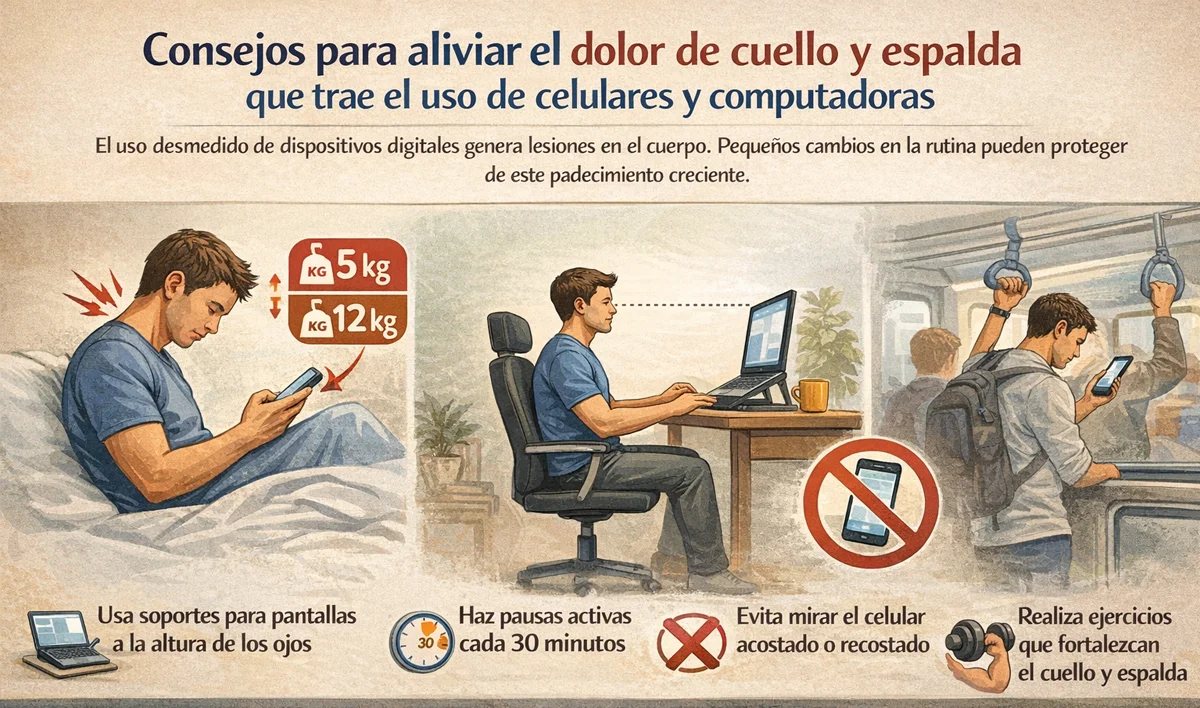
A proper posture, she explains, includes keeping the back fully supported against the chair's backrest, feet firmly on the ground, and elbows forming a 90-degree angle. The screen should also be at eye level, more precisely aligned with its upper third, to avoid forcing the neck down. To achieve this, she recommends using laptop or monitor stands, one of the simplest and most effective ways to prevent pain.
Even with an ideal posture, remaining still for long periods is also harmful. From NorthEast Spine and Sports Medicine, a center specialized in the spine, they recommend taking active breaks every 30 minutes. Just standing up, walking a bit, or stretching the arms is enough to prevent the joints from becoming strained.
Using a phone in bed: a more harmful habit than it seems
Many people start the day by checking their phone from bed, in a semi-reclined or side position. Although it seems harmless, this gesture can significantly increase pressure on the neck.
Valensky warns that by tilting the head forward, even just 15 degrees, the weight supported by the cervical spine can double. While an upright head generates pressure of about 5 kg, tilting it just a few degrees can make that load reach 12 kg. This can lead to sustained tension and, over time, chronic pain.
The expert's suggestion is to avoid using the phone until seated properly, with a straight back, elbows resting on the legs, and the neck in a neutral position. If using it in bed is unavoidable, this is the posture that best preserves the health of the cervical vertebrae.
The risks of looking at your phone on public transport
Another critical moment for cervical health is using a phone while standing on public transport. In that situation, most people tilt their heads forward and lower their gaze. Over time, this creates constant pressure on the C7 vertebra, located at the base of the neck.
According to Valensky, this repetitive posture can lead to a visible deformity: a bump in the lower neck area, which in some cases evolves into a herniated disc, a painful condition that affects the intervertebral disc and may require medical treatment or even surgery.
To prevent this, she recommends avoiding phone use while standing. Ideally, it should be used while seated, resting the elbow on a leg or railing and keeping the neck at a slight tilt, without straining the cervical muscles.
Exercise as a form of prevention
One of the best allies for preventing so-called “tech neck” is regular physical exercise. Lack of activity weakens the neck muscles, making them more prone to tension and pain in response to any poor posture.
From NorthEast Spine and Sports Medicine, they suggest incorporating routines that strengthen the cervical area and trapezius muscles, which extend from the base of the skull to the mid-back. These muscles are constantly activated when using computers, tablets, and phones, even if it is not perceived.
By strengthening them, natural posture improves, the risk of muscle contractions decreases, and the weight of the head does not fall entirely on the cervical vertebrae. Even simple stretching exercises, performed twice a day, can make a significant difference.
Habits that most affect your neck and back without you noticing
Neck and back pain does not appear overnight. It develops over time, stemming from small gestures that we repeat daily. Some of the habits that most affect the spine, according to specialists, are:
- Looking at your phone while lying down or reclined
- Tilting your head forward for hours
- Working with the screen too low
- Remaining still for long periods
- Using devices while in motion, without supporting the arms
- Ignoring pain or stiffness at the end of the day
Changing these habits for healthier options can relieve neck and back pain without the need for medication. It is enough to adopt a correct posture, move occasionally, and keep the muscles active.
As Valensky points out, “good posture is as important as a good diet.” The way we sit, walk, or use our phones can have a direct impact on our physical health. And the sooner these mistakes are corrected, the better the prognosis will be.