Joe Dispenza: Start to "remember the future" if you are already tired of repeating the past over and over again.
Joe Dispenza explains how to reprogram the mind, leave the past behind, and manifest a new life with elevated emotions and active awareness.
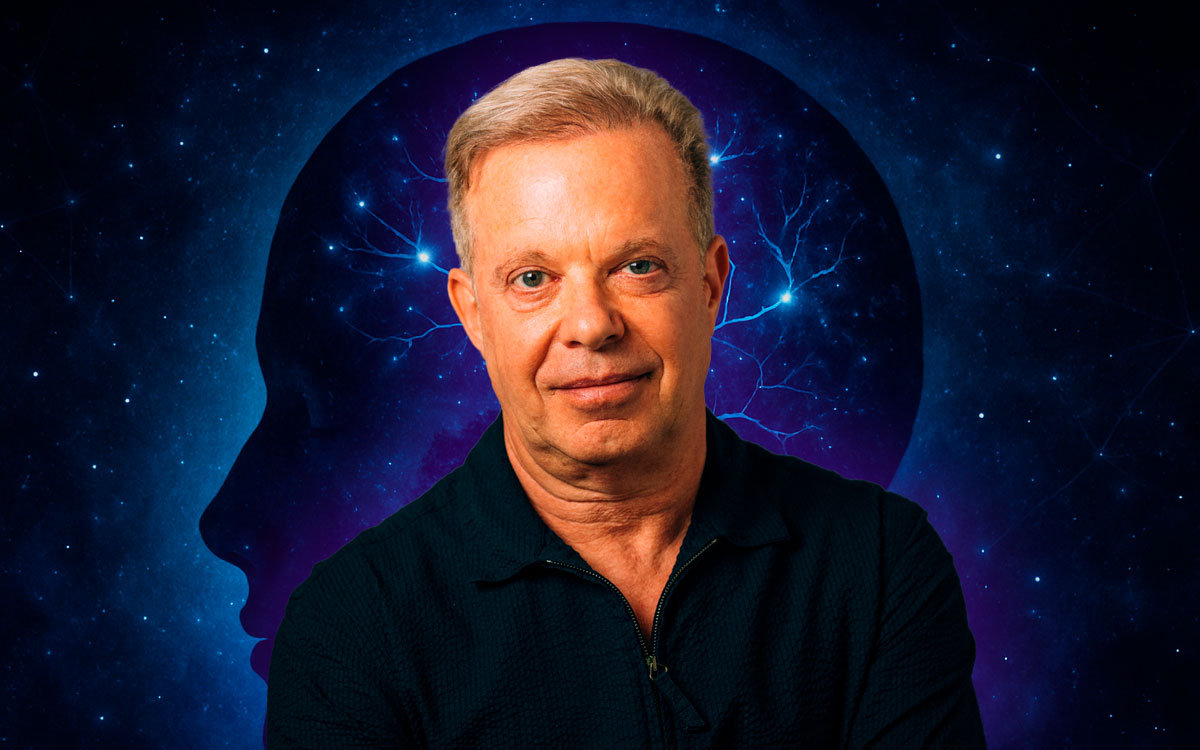
What if they told you that you can change your life by changing the way you think and feel?
Joe Dispenza, a recognized researcher in neuroscience and spirituality, teaches how to become the conscious creator of your reality.
What if the truth is that you are greater than you think, more powerful than you know, and more unlimited than you could dream?
- Feel the future before living it:
The key to manifesting what you desire is to feel the emotion of that future as if you were already living it. Gratitude, joy, fullness, and love are the emotional states that reprogram your mind. - Your personality defines your reality:
If you want your life to change, you first need to stop thinking, acting, and feeling the way you do now. Transformation is internal. - Negative emotions keep you stuck:
Living with guilt, anger, or fear means staying connected to the past. To move forward, you need to free yourself from those emotions and create a new state of being. - Coherence between mind and heart:
When your heart vibrates with positive emotions and your mind has clarity, a powerful energy is generated that transforms your body and your environment. - Design your life from vision, not from pain:
You don't need to wait for a crisis to change. Visualize the future you desire and act in coherence with that version of yourself.
The secret is within you: the key to transforming your reality
How to reprogram your mind is not a magical concept or an esoteric idea without scientific basis. It is an accessible, powerful, and deeply transformative process that can radically change your life if you decide to apply it intentionally. This is how Dr. Joe Dispenza, a recognized author and neuroscientist, presents it, asserting that you are not a victim of your reality, but the active creator of it.
Through his research and workshops, Dispenza has shown how our thoughts, emotions, and behaviors shape the experience we live day by day. According to him, the key is to feel the emotion of the future we desire before it happens. This approach allows us to shorten the distance between thought and experience, thus creating a new personal reality.
Getting out of autopilot: the first step towards change
To create a different life, it is not enough to wish for it. Dispenza explains that it is essential to become aware of the unconscious thoughts that limit us. Phrases like “I can’t,” “I will never change,” or “it’s my past’s fault” are clear indicators of a mind programmed by lack.
If we want to become a new version of ourselves, we must break those patterns. The first step is to observe them. The second is to replace them with thoughts and emotions that are aligned with the reality we wish to experience. It is not an act of faith without basis, but a mental training that, with consistency, reconfigures the brain and the body.
Emotion and body: the portal to the future
Dispenza argues that the body is the unconscious mind. When we feel emotions like fear, guilt, anxiety, or frustration, we anchor ourselves to the past. These emotions arise from memories that remain active, even though the event has already passed. The challenge is to overcome them emotionally to stop living from scarcity and start acting from abundance.
Feeling the emotion of the desired future—as if it were already happening—is the true act of creation. By doing so, the brain does not distinguish between what is real and what is imagined. Thus, the body receives an emotional preview of the future, and we begin to act as if we already lived in that new reality.
Personality creates personal reality
One of Dispenza's most powerful phrases is: “Your personality creates your personal reality.” What you think, how you act, and how you feel define your current life. If you repeat the same thoughts, maintain the same habits, and react in the same emotional way, you will get more of the same.
That’s why, to create a new reality, you need to become another person. One who thinks, acts, and feels differently. That transformation requires deep work of self-observation, discipline, and constant practice.
The experiment: be the creator, not the victim
Many say they practice meditation to heal. But according to Dispenza, the true reason must be to change. Healing is the result. What matters is to transform internal energy, sustain it, and reproduce it every day, without depending on the external to feel whole.
“How many times do you have to forget until you stop forgetting and start remembering,” he says. In other words, it is about practicing until that new emotional state becomes your norm. When this happens, we begin to see synchronicities that confirm we are on the right path.
Lack has no place in abundance
You cannot create abundance from the emotion of lack. Those who desire wealth, love, or health must start by feeling as if they already had it. That is the only way they can authentically and sustainably attract it. This implies, for example, stopping complaining, blaming the environment, and waiting for something external to make them happy.
Instead of waiting for the perfect relationship to feel love, or the promotion to feel fulfilled, one must start by embodying those emotions here and now. From that elevated energy, decisions, habits, and ultimately results are transformed.
Trauma is not eternal: the story can be rewritten
The past not only lives in the brain; it also resides in the body. Dispenza asserts that the emotions derived from traumatic experiences can be reactivated by simply remembering the event, producing the same chemicals and biological responses as if they were happening again. Overcoming those emotions is essential to overcome the past.
What’s the solution? Feel more intense and elevated emotions linked to the future we desire. If we manage to make those emotions mark our nervous system, the body and the brain begin to reconfigure. In fact, studies conducted by Dispenza's team show that people's biology can change in just seven days of intense practice.
Abundance as a creative experience
Dispenza also offers a powerful view on money and abundance. According to him, money is neither good nor bad; it is simply an experience that can be lived if we are in coherence with our values. The problem arises when we use money to reaffirm emotions of scarcity or fear.
The best way to attract abundance is to become excellent at something valuable. Doing so from passion and purpose creates an energy that inevitably attracts resources, opportunities, and connections. Abundance, then, is not chased: it is expressed from the inside out.
The highest motivation: a mission with purpose
There are different types of motivation. For Dispenza, the lowest is motivation for money. The highest are those that arise from personal conviction, solid ethics, or, even better, from a life mission. People with a vision larger than themselves are the ones who achieve lasting changes, not only in their lives but in the lives of those around them.
A person who wants to change, who wishes to create something different, must stop defining themselves by their past and start defining themselves by their vision of the future. Doing this, day after day, with discipline, is what ultimately allows one to become a new being.
The role of parents: modeling their children's future
Children learn by imitation. Mirror neurons replicate the behavior they observe. If parents live in stress, anxiety, or frustration, children absorb it without filters. This programs them with emotions and beliefs that will later define their lives.
Being a parent, Dispenza says, is a fast track to enlightenment. It is not about telling them what to do, but about showing by example how to live from coherence, calm, and connection. If the adult changes, the child changes.
"Start remembering the future"
The phrase "start remembering the future" may seem paradoxical at first glance. However, it contains an invitation to reflect on how our past and present experiences shape our expectations and projections toward what is to come. This concept suggests that, just as we remember the past, we can "remember" or anticipate the future based on patterns, knowledge, and previous experiences.
Prospective memory and its role in anticipation
Prospective memory refers to the ability to remember to perform actions in the future, such as remembering a medical appointment or sending an important email. It is an essential cognitive function that allows us to plan and coordinate our daily activities. According to the Encyclopedia of Memory, this ability involves both automatic and controlled processes, and its effectiveness may depend on factors such as the importance of the task and environmental cues that remind us of the pending action.
Visualization and planning: tools to "remember" the future
Visualization is a technique used in various fields, from sports to psychology, that involves imagining future scenarios to prepare for them. By vividly visualizing an upcoming situation, our brain activates circuits similar to those that would be activated if we were actually experiencing that situation. This can enhance our performance and reduce anxiety about future events. Strategic planning, on the other hand, allows us to set goals and outline the necessary steps to achieve them, facilitating effective preparation for what is to come.
It’s not magic, it’s science and awareness
You are more powerful than you believe and can be the creator of your reality. To change your life, you first have to change your personality (thoughts, emotions, habits). The emotions of the past keep you tied to the past; you need to feel the emotion of the future to create it. Feeling gratitude for what has not yet happened is the ideal emotional state to attract that reality.
Most people wait for a crisis to change, but it can be done from the vision of a desired future. Change is uncomfortable: it involves making different decisions every day.
The body and mind are reprogrammed when you live in elevated emotional states like love, gratitude, or joy. Stress and negative emotions wear down the body, weaken the immune system, and activate disease genes.
Coherence between heart and mind generates real transformations in the body and in life. We teach by example: our children learn from our emotions, not from our words.
If you manage to sustain the emotion of the future you desire, your body, your mind, and your reality will begin to align with that vision.