Why do dogs shake when they are wet?
Harvard experts explain from a fascinating perspective this evolutionary instinct and the sensory abilities of dogs and other mammals.
A reaction that goes beyond dogs
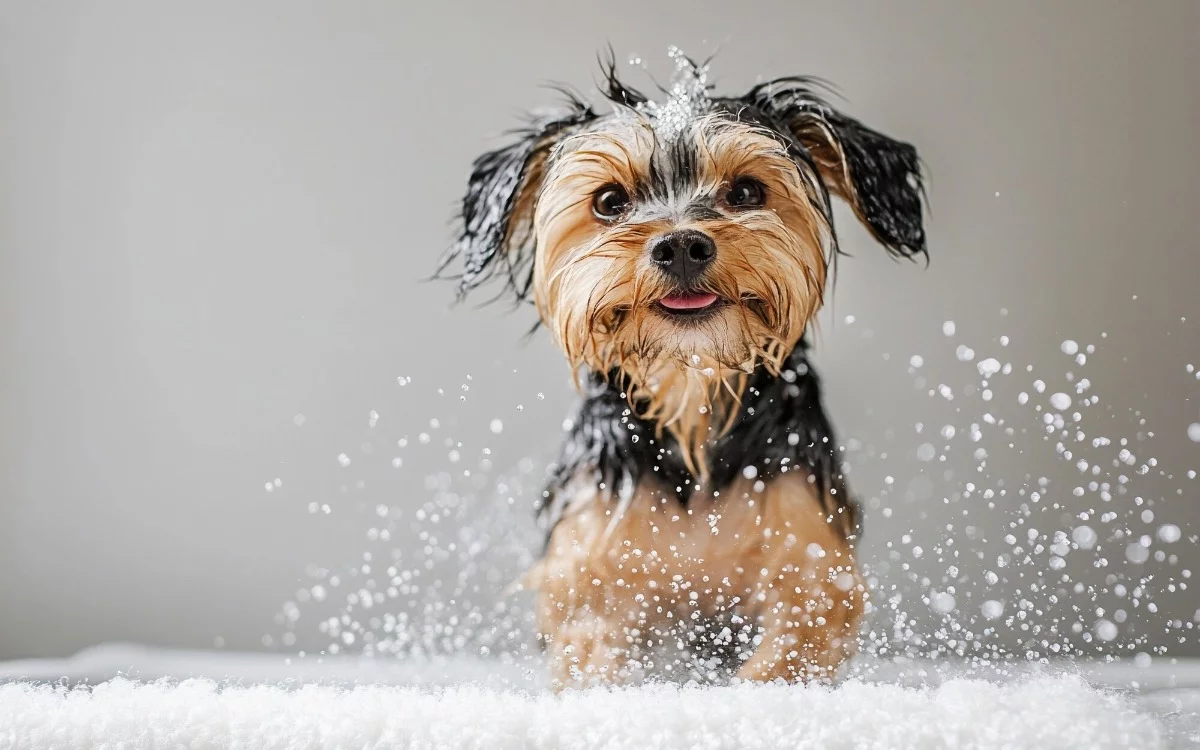
Dogs, like other mammals, tend to shake vigorously when wet, in an effort to remove excess water from their bodies. What seems like a simple instinctive act is actually an evolutionary adaptation that, according to a study conducted by a team of neurobiologists at Harvard Medical School, is essential for their survival in the natural environment. The research focused on understanding the neural and motor circuits that enable this reaction not only in dogs but also in animals like bears and mice. These precise and effective movements help them stay dry, reduce body weight, and avoid problems associated with wet fur.
In the study, experts analyzed how the neural system allows the body to detect the presence of water or irritants on the skin and trigger the shake. This reflex, observed in various mammals, is essential for staying dry in adverse conditions. Thus, shaking is configured as an evolutionary strategy that contributes to the well-being of animals and gives them an advantage in their natural environment.
The scientific basis of shaking in mammals
To understand the origin of this behavior, researchers conducted experiments with mice. During the tests, they applied different stimuli to specific areas of the rodents' bodies, such as the neck and back, using air and oil to provoke a reaction similar to that caused by water. The results showed that, upon receiving these stimuli, the mice began to shake in response, indicating that the behavior is an innate mechanism for dealing with external discomforts, whether water or physical irritants.
The research focused on discovering whether the animals' reaction depended on the activation of receptors in the skin sensitive to physical stimuli or if it also responded to changes in temperature. To do this, the team decided to genetically manipulate some mice by eliminating the Piezo2 gene, which is key in the tactile sensory system. This genetic modification allowed scientists to determine that the absence of Piezo2 eliminated the shaking response in the mice, confirming its central role in the perception of external stimuli.
The role of the Piezo2 gene in the shaking reflex
The Piezo2 gene, responsible for the ion channels involved in tactile perception, has been extensively studied in the field of neurobiology. This gene is responsible for activating the mechanoreceptors in the skin, which are activated by pressure or contact with liquids and other irritants. By eliminating Piezo2 in the test mice, researchers found that the shaking reaction disappeared, demonstrating that this gene is essential for the process. This finding not only helps to understand the reaction in dogs but also in other mammals that depend on this reflex to survive in the wild.
In addition to Piezo2, researchers identified specific receptors that participate in this reflex. These receptors, known as C-LTMRs, consistently responded to stimuli in the fur, triggering the shake. When scientists deactivated the C-LTMRs in the mice, they observed a significant decrease in the frequency of this response, reinforcing the idea that C-LTMRs are a key component in the sensory system that controls the shaking reflex in mammals.
A well-defined neural process
To achieve a comprehensive view of this reflex, the team developed a detailed outline of the neural process that follows the "wet dog shake." First, sensory stimuli on the skin are transmitted through the spinal cord to the brain. Once these signals are processed, the brain sends instructions to the motor system to initiate the shake, a highly coordinated response that effectively removes excess water. This process is an adaptation that has evolved in mammals to protect against diseases or problems arising from wet or dirty fur.
The shaking reflex in dogs and other animals has a clear evolutionary advantage: by drying off quickly, they avoid problems of hypothermia, infections, or simply the discomfort of carrying extra weight, which affects their mobility. In the wild, an effective shake allows them to conserve energy and maintain good physical condition, which is essential for their survival.
Communication with dogs: the language behind "good boy"
In addition to understanding the mechanism that leads dogs to shake, experts have also explored how these animals manage to understand and respond to our voice commands. Although dogs do not speak, they have a special ability to interpret the tone, rhythm, and content of our words, allowing them to respond to commands like "sit" or "come here." A recent study led by researcher Eugénie Déaux revealed that humans naturally adjust the rhythm of our voice when speaking to dogs, which facilitates communication between the two species.
This phenomenon is known as dog-directed speech (DDS), a style of communication that we use unconsciously when interacting with our pets. In contrast to the language we use among adults, DDS is more measured and has a higher pitch, making it easier for dogs to understand. According to the study, instead of the 4 syllables per second of typical human speech, when addressing a dog, we tend to slow down to 3 syllables per second.
The brain rhythm of dogs and how they process our words
To study how dogs' brains process human language, researchers used electroencephalography (EEG). They discovered that while humans process speech at a brain rhythm known as theta, between 4 and 7 Hz, dogs use a slower rhythm called delta, between 1 and 3 Hz. This difference in brain rhythm is key to understanding how dogs interpret our words, as their auditory system is adapted to process sounds in a slow and specific manner.
The ability of dogs to respond to human words and gestures is not just a product of their training but an evolutionary adaptation in their auditory perception. By capturing words at a slower pace, dogs have developed a skill that makes them more receptive to the tone and intent of our words, strengthening the bond between humans and pets.