Five years after the pandemic: what happened to our desire to leave the big cities?
Five years after the pandemic began, this report investigates how the desire of Argentines to migrate from metropolises to smaller cities or the countryside has evolved.
On March 20, 2020, the social, preventive, and mandatory isolation ordered by the national government began, in order to prevent the circulation and contagion of the COVID-19 virus. This measure, which forced most of the urban population to stay at home, highlighted the significant housing deficit that our country was already suffering, especially in large urban areas. From this moment on, not only were the problems of access to housing and decent living conditions made even more visible, but other urban life issues that had previously been normalized began to be questioned. In this context, for many urban dwellers, the possibility of living in smaller cities or directly in rural areas became an urgent desire, while remote work and distance education seemed to pave the way for this new way of life.
The Sick City
The restriction on movement imposed by the National State and supported by other levels of government had an unequal impact on different sectors of society. While some were able to undergo a safe quarantine, protected from possible infections, for others, isolation meant a disarticulation of social networks, a reduction and even disappearance of their income, changes in their working conditions, among other issues. But above all, the mandatory quarantine highlighted the enormous housing deficits in our country. Thus, structural, complex, and diverse problems became urgent on the public agenda: overcrowding, precariousness, lack of connectivity, family indebtedness, informal evictions without registration or protection, landlords and real estate agents speculating outside the laws regulating the market, lack of public spaces, overburdening regarding care tasks, among others.
The quarantine also meant that a large number of people had to transform their work dynamics to remote work, as well as perform other daily tasks remotely: teaching or studying, shopping, entertaining themselves, exercising, medical consultations, etc. The adoption of virtuality required improvements in the technologies and connectivity available in households, as well as changes in family dynamics and the use of space within homes.
All these transformations, combined with the dissatisfaction that many citizens already had prior to the pandemic regarding the cities they inhabited, enabled many individuals and families to reconsider the need to continue living in a metropolis. This was reflected, from 2020 and throughout the pandemic, in various journalistic articles. For example, an article from the newspaper La Nación on August 4, 2020, was titled: “"I’m moving to the countryside": why more and more people are choosing to leave the city.” A month earlier, Hoy de La Plata posed the question: “Leaving the city: more and more families are betting on small towns.” La Gaceta de Tucumán followed the same line in 2021: “Moving and teleworking: inquiries to leave the city are increasing.” These are just a few examples of the various articles and chronicles that recorded this new interest in abandoning urban centers and moving to small cities, towns, or even the countryside.
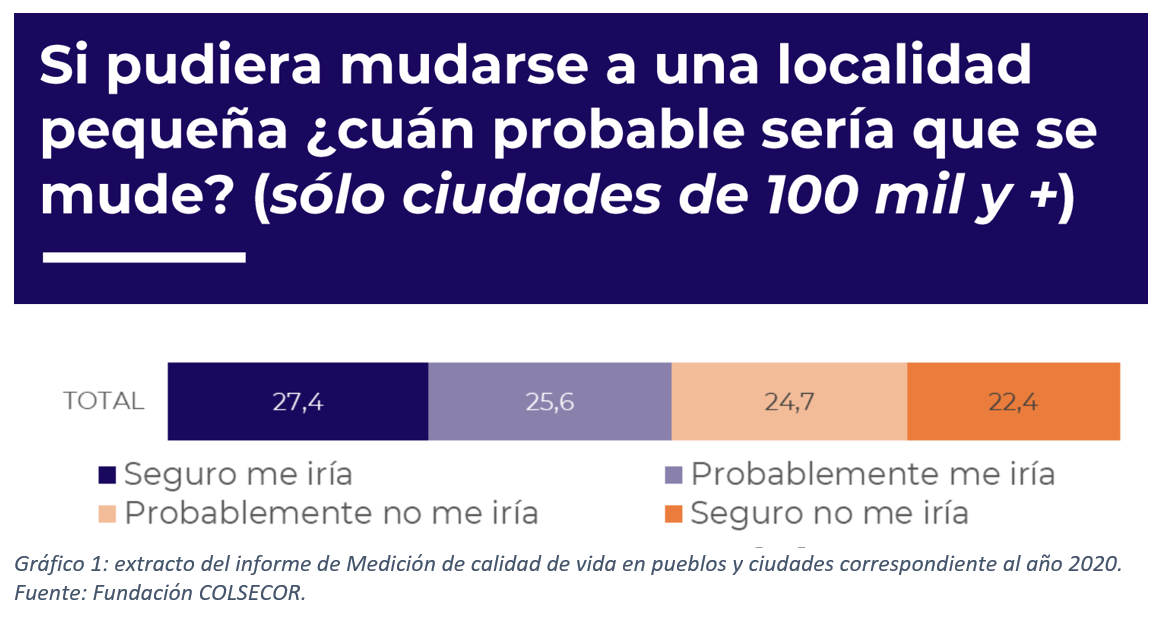
These articles merely reflected that trend which, during the quarantine, emerged from urban societies. At that time, a report prepared by the Gente en Movimiento observatory, coordinated by journalist and deputy Gisela Marziotta, was made public. In that work, it was observed that among the inhabitants of the Federal Capital aged 16 to 50, 55% of those surveyed expressed a desire to move out of the city. The percentage dropped to 50% among respondents aged 51 to 60. In the same vein, the Colsecor Foundation, an organization linked to various cooperatives in the interior of our country, reflected in its Quality of Life Measurement in towns and cities for the year 2020 that among respondents from cities with more than 100,000 inhabitants, 27.4% would move to a smaller locality, while another 25.6% would probably do so.
The Pandemic: A Window of Opportunity
In the context of a pandemic that primarily affected large urban centers and with a significant portion of the population wishing to change their place of residence, we can understand that between 2020 and 2021 there was an opportunity to construct a solution to two major problems that our country has historically faced: the deficient living conditions suffered by large urban masses and the excessive concentration of population in large urban centers. John Kingdon suggests that these situations can be understood as “windows of opportunity,” and that to take advantage of them positively, they require the confluence of three issues: the emergence of a socially problematic issue, a political will to resolve it, and a technical solution to the problem. If any of these three issues fails, clearly the problem will not only remain unsolved, but the social interest that may have been built around the issue will also be lost.
We have already seen how society played its role in questioning the precariousness of urban life, as well as expressing the need for life in environments with greater social proximity and stronger ties to nature. Likewise, various actors in the economy, production, and education, among other fields, sought to adapt, as much as possible, to the new remote proposals that the health context required. Even the idea of “returning to the countryside” had already been promoted by various actors in the moments leading up to the pandemic. Perhaps one of the most important cases from academia is the work of Marcelo Sili, who has been observing the process he has termed “Rural Rebirth” since the 2000s, strongly betting on the rediscovery of the potential that rural spaces present compared to urban ones, based on the consolidation of a new rural identity, with the capacity for innovation, but above all, from the perspective of thinking about an inhabited rurality.
In this line and from the field of social organizations, the Es Vicis Foundation arrived at the pandemic with its “Welcome to My Town” program underway. This is an initiative that had its pilot test since 2016 in Colonia Belgrano, a small locality in southern Santa Fe, and seeks the sustainable and planned repopulation of small localities, promoting local development and the rooting of young people. During the first months of the pandemic, according to its director, Cintia Jaime, the organization saw a tripling of inquiries related to the program from people looking to leave the city.
However, the other two issues raised by Kingdon, political will and a technical solution to the problem, were glaringly absent. In general, the policies proposed by the Frente de Todos government at the national level tended to address the emergency and did not take advantage of the context to incorporate structural changes. For example, the “Habitar la Emergencia” program created under the Federal Program Argentina Construye did not propose any specific lines for smaller localities, let alone actions aimed at rural habitats. There were also no national or provincial policies that incentivized population mobility or facilitated access to housing for those wishing to settle in a small locality.
Some other state actions that could have had a significant impact in this regard were the National Urban Land Plan and the relaunch of Pro.Cre.Ar. However, both initiatives had limited or no reach to smaller localities, failing to offer alternatives that fit the demands or possibilities that such environments require. Finally, no tools were generated for local governments to seek new residents, improve their housing stocks, especially recovering those that are unused due to lack of demand, or at least, to guarantee the retention of their youth by expanding educational offerings or access to the labor market, taking advantage of new virtual tools.
5 Years Later: Where Are We?
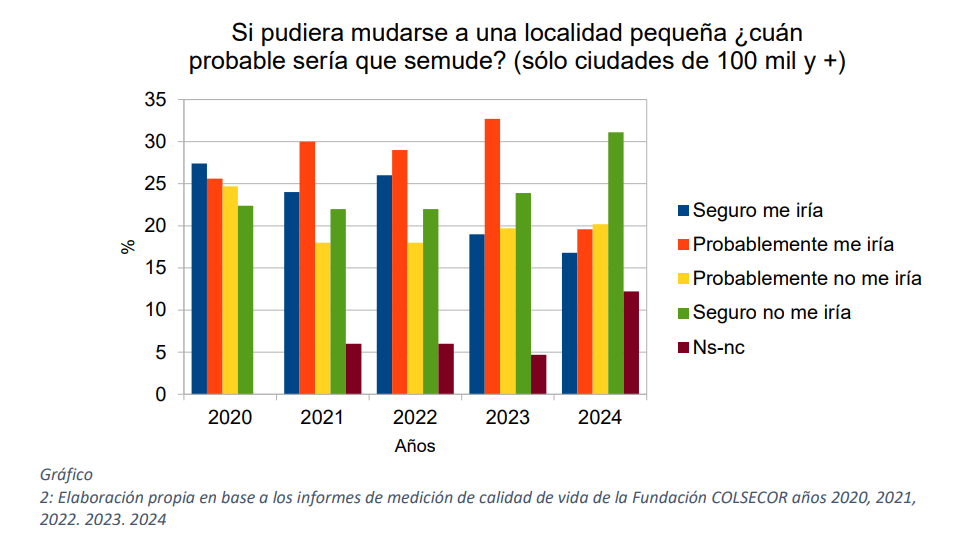
If there is something characteristic about “windows of opportunity,” it is their short duration, and this case was no exception. This is evidenced, for example, through internet searches that users have conducted from 2020 to the present. According to Trends, Google's platform for visualizing statistics related to various terms used in its search engine, in Argentina, terms like “leaving the city,” “towns to live in,” or even the famous “houses for 1 euro” reached their peak popularity between 2020 and 2021, coinciding with the most rigorous moments of the quarantine and, of course, with the dissemination of the aforementioned journalistic articles. From 2022 to the present, this type of search has been in constant decline. The same loss of interest is verified in subsequent surveys conducted by Colsecor: while in 2020, more than 27% of the inhabitants of large cities expressed their desire to leave, by 2024, the number fell to just over half: 16.8%.
The deepening of the economic crisis in the last stage of the Frente de Todos government and the change of government at the national level at the end of 2023 also did not help to materialize, in many cases, the desire to leave the city. The rise in unemployment since the assumption of the libertarian government is not limited to large cities; it also affects the limited labor markets of small localities. The mortgage credit, which grew in this last administration, is not accessible to everyone, while it requires certain formalities that many properties located in towns and cities in the interior do not meet. The shrinking of the State in general, promoted by the logic of the “chainsaw,” undermines any counter-hegemonic trend seeking to decentralize the population and which requires strong state support.
However, not all is lost. Outside our country, other states did take advantage of this opportunity. This is the case of Spain, which during the pandemic and in response to the same desire to leave cities and populate the territory, created the General Secretariat for Demographic Challenge in January 2022, seeking from a comprehensive perspective and multi-level governance to achieve for rural environments and small localities a quality of life comparable to that of large urban centers, reduce territorial vulnerability, and reverse the historical inertia of metropolization. All this is materialized through the plan of 130 measures against the demographic challenge, which includes issues related to ecological and digital transition, full connectivity of the territory, development of sustainable tourism, business promotion, support for youth and women, strengthening public services, development of social welfare, care economy, and promotion of culture.
Returning to our country, the aforementioned Es Vicis Foundation is advancing with its sustainable repopulation project, incorporating new municipalities and coordinating with more families. Since its implementation began, the “Welcome to My Town” program has been requested by more than 200 localities. They have also received applications from over 40,000 people looking to migrate to a small locality. This is in addition to other actions such as the creation of agroecological colonies carried out by the Union of Land Workers, which is well reflected in the documentary “Returning to the Countryside: Peasant Struggles for Good Living.”
In short, the pandemic was an opportunity to solve a historical problem in our country, such as the excessive concentration of population in large cities, also contributing to the improvement of the quality of life in cities and towns. However, once again, this did not happen. The interest of society in a life away from large urban centers, with greater social contact and connection to nature, was wasted. There was also no response to the structural problems that motivate migration from towns to large cities, among which are the difficulty of accessing work, low quality of internet access, lack of good physical connectivity, access to housing, among others.
However, this window served to make visible, albeit in a limited way, the benefits and challenges faced by those who decide to leave the big city to settle in a small locality. Also, although it did not become a massive movement or one supported by the State, many individuals and families did indeed move from large urban centers to smaller cities and towns. This was reflected in the 2022 Census, which confirmed the growth trend already presented by coastal municipalities and especially the cities and areas that stand out from the rest due to their natural attractions. Thanks to the visibility of these experiences, the study of small localities and rurality as inhabited space is gaining strength within various fields of knowledge, forming a virtuous circle in pursuit of a rural future.