The surprising NASA photo that shows a "dolphin" on Jupiter: what is behind the phenomenon
Dolphin on Jupiter: the NASA image that left everyone speechless.
Scientists analyzing the data sent by the Juno probe from NASA were taken by surprise when they discovered an unmistakable shape in Jupiter's clouds: the silhouette of a dolphin that appears to be swimming in the atmosphere of the giant planet. This image, processed by experts from the U.S. space agency, caused a worldwide stir, not only because of the quality of the captured data but also due to the singular detail that, at first glance, defies logic.
Through a new photo of Jupiter, it was observed how one of its characteristic cloud formations took the exact shape of a dolphin, a visual phenomenon that illustrates the mysterious workings of the atmosphere of the largest planet in the solar system. Although this is not the first time such figures have emerged in space images, the similarity between the cloud and the animal has left both scientists and the public perplexed.
A dolphin in Jupiter's sky: the photo that amazed scientists
The image in question was shared by NASA and quickly began to circulate on social media, capturing the attention of thousands of people who wondered how such a familiar shape could be seen more than 600 million kilometers away. The cloud formation was captured in a region of the planet located between 32 and 59 degrees south latitude, in the area called the Southern Temperate Belt of Jupiter, a zone where clouds and winds interact in fascinating ways.
The Juno space probe, which has been exploring Jupiter since 2016, has the mission of studying the atmosphere and magnetic field of the planet, among other aspects. To achieve this, Juno is equipped with the JunoCam camera, which captures and sends images of this gas giant back to Earth. However, before reaching the public, these images are meticulously processed by teams of scientists, who analyze the visual data in detail.
Scientists Brian Swift and Seán Doran, who work with NASA on editing images captured by Juno, were the ones who revealed the surprising figure of this “dolphin,” an astonishing example of pareidolia. This psychological phenomenon consists of seeing familiar shapes in random objects and patterns; in this case, the sharp profile of a dolphin in a cloud on Jupiter.
Jupiter's atmosphere and its mysterious cloud formations
The atmospheric environment of Jupiter is particularly dynamic, composed of clouds, storms, and powerful wind currents that give rise to astonishing figures and patterns in the gas that makes up its surface. In the atmosphere of this planet, massive storms and large cyclones are generated that move at high speeds. The complex interactions of gases and pressure in its upper layers form clouds and structures that sometimes resemble recognizable figures, as in this case.
Unlike Earth, where water clouds predominate, on Jupiter these formations are primarily composed of gases such as ammonia and methane. The dolphin captured by Juno appears to float in a colorful cloud environment due to the different elements that make up the planet's atmosphere. These clouds are constantly moving and dancing, forming unusual patterns that allow scientists to indirectly study the internal dynamics of Jupiter.
Additionally, the planet has zones and bands of different coloration due to its powerful climatic and wind systems. These bands are in constant motion, leading to the formation of different figures in Jupiter's gaseous surface, some of which may resemble familiar objects, as happened on this occasion.
The Juno mission: a camera that reveals Jupiter's secrets
Launched in 2011 and active in Jupiter's orbit since 2016, NASA's Juno mission seeks to understand the origin and evolution of Jupiter. Juno was designed to orbit in the outer space of the planet and send high-resolution images back to Earth that allow scientists to analyze its atmosphere, structure, and internal composition. Among the data sent to NASA are photographs taken by the JunoCam camera, which has allowed for precise observation of everything from large storms to phenomena like the silhouette of the dolphin.
The photographs captured by Juno also allow for the study of other aspects of Jupiter's dynamics, such as its magnetic field, its poles, and the changes occurring in its atmosphere. This mission has not only provided impressive images of Jupiter but has also revealed key data to understand how the giant planet formed and evolved.
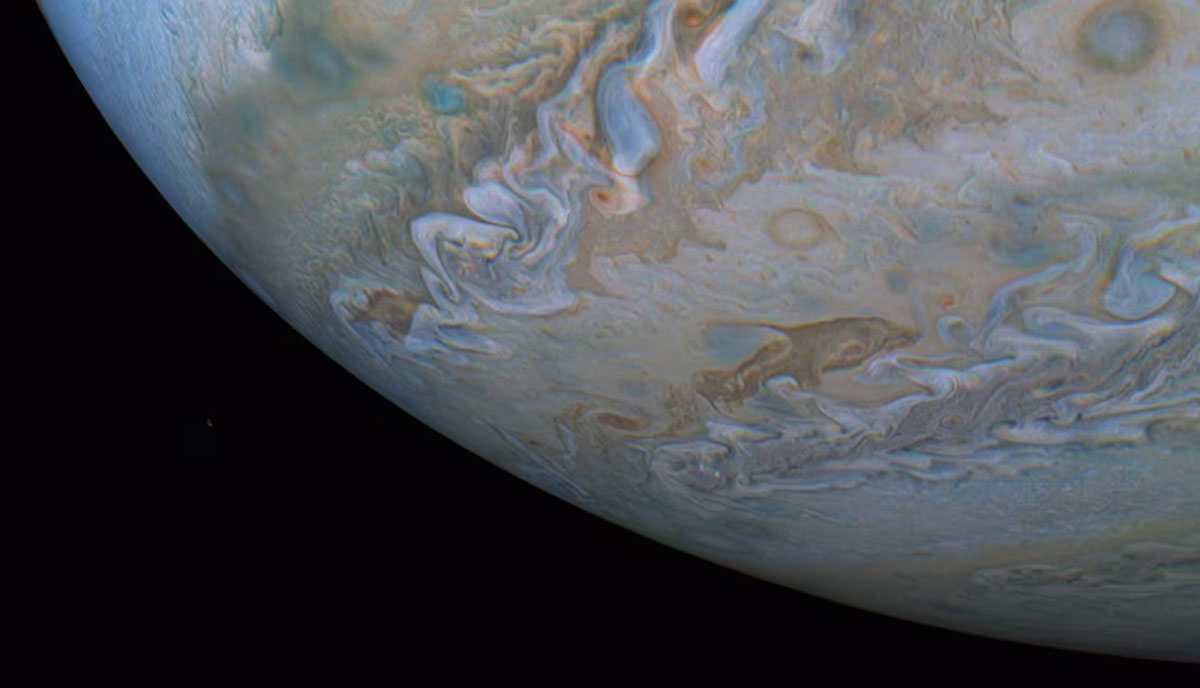
The image of Jupiter in which the dolphin can be seen. (Photo: NASA/@_TheSeaning)
Since its launch, the probe has fulfilled multiple scientific objectives, achieving a better understanding of Jupiter's magnetic field and its complex wind systems. In each flyby, Juno approaches about 4,200 kilometers from Jupiter's clouds, allowing for unprecedented direct capture of details of its features.
Pareidolia and its role in human perception
The visualization of shapes in random patterns is a common phenomenon, and in the case of the dolphin on Jupiter, pareidolia has made its presence felt once again. This phenomenon is as old as humanity itself and is related to the way the human brain interprets visual stimuli. When seeing something unknown or confusing, the mind seeks a familiar reference, such as figures, faces, or animals, to help make sense of the image.
This tendency has an evolutionary basis, as humans are programmed to find meaning in what they observe. Pareidolia has also been documented in other celestial bodies, such as the famous “face on Mars” or certain formations on the Moon. These images are merely interpretations of our mind, which tends to give a familiar shape to unfamiliar visual stimuli.
In the case of the image of Jupiter, the gaseous formation and the angle of the photo led many to see a dolphin, although the cloud is actually a composition of gases moving rapidly in the planet's atmosphere.
Other examples of unusual figures in space
The photo of the “dolphin” on Jupiter is not the first occasion when a recognizable figure has appeared in space. Over the years, NASA and other space agencies have captured images of what seem to be known objects on planets and moons. One of the most famous cases is the so-called “face on Mars,” a formation on the surface of the red planet that appeared to have human facial features when photographed in 1976. Although it was later shown to be just a combination of light and shadow, the phenomenon was a classic example of pareidolia in space.
More recently, formations resembling everything from animals to “spaghetti” have also been photographed on Mars. These perceptions remind us that the human brain always seeks patterns, even in situations where there are simply random shapes.
The image of the dolphin on Jupiter is a new example of how perception phenomena can play an important role in our way of seeing the universe. The images captured by NASA in its missions allow us to observe space like never before, and in doing so, we sometimes find something that reminds us of what we already know here on Earth.