Sagittarius A*, the black hole at the center of the Milky Way, reveals a new type of energy never before observed.
What did scientists discover near the black hole… that no one expected to see?
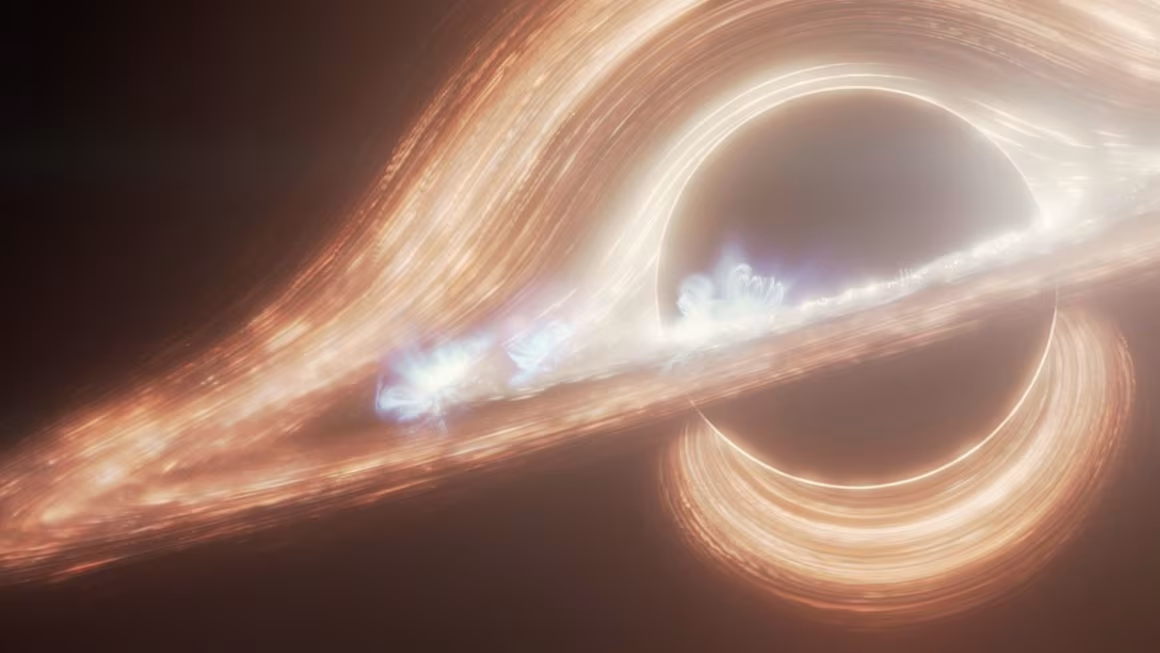
In the most extreme and mysterious environment of our galaxy, an unprecedented discovery has just shaken the field of astrophysics. An international team of astronomers, using the South Pole Telescope, managed to detect stellar flares with a power never before recorded near the supermassive black hole at the galactic center, located 26,000 light-years from Earth, in the constellation Sagittarius.
These energetic emissions, published in the journal The Astrophysical Journal, reveal magnetic processes of colossal intensity, impossible to study from other regions of the universe. And although they are brief, each flash acts as a natural diagnostic tool: it allows scientists to observe how matter and energy behave under extreme gravitational and magnetic conditions.
A telescope in the frozen heart of the Earth
The observations were made possible thanks to the South Pole Telescope, located in one of the most isolated and coldest points on the planet. From this Antarctic station, astronomers can look towards the core of the Milky Way without the humid atmosphere or other interferences altering the data.

This instrument operates in the millimeter range of the electromagnetic spectrum, allowing it to penetrate the dust veil that normally prevents direct observation of the galactic center through optical telescopes. With this advantage, images and measurements were obtained with unprecedented accuracy.
What these stellar flares are
The detected flares do not originate directly from the black hole, but from stars that orbit very close to it. These stars are exposed to extreme gravitational forces and physical conditions that force them to adapt to survive.
Astronomers explain that the flares originate from magnetic reconnection events. This phenomenon occurs when the magnetic field lines of the stellar atmospheres break and reconnect, releasing enormous amounts of energy in the form of radiation.
While the Sun in our system produces eruptions that can affect satellites or power grids, the flares near the galactic center are several times more intense, and constitute a natural laboratory for studying the most extreme physics of the universe.
A violent and unexplored environment
The central black hole of the Milky Way has a mass equivalent to four million suns. Around it, stars orbit at dizzying speeds, immersed in a chaotic dance governed by gravity. This environment is not only hostile but also fascinating: it combines intense radiation, stellar density, and distortion of spacetime.
Each observed eruption offers valuable clues about:
- The magnetic structure of the stars.
- The gravitational dynamics in regions close to the black hole.
- The mechanisms of stellar survival under extreme conditions.
According to experts, studying these flares allows us to identify which types of stars manage to withstand these conditions and how they evolve over time.
Towards a new understanding of the galactic center
Until now, the center of the galaxy was largely inaccessible to astronomy. The density of dust and gas hindered precise measurements. But with technologies like the South Pole Telescope, this region is beginning to reveal its secrets.
The team led by the University of Illinois at Urbana-Champaign and the National Center for Supercomputing Applications anticipates that new observation campaigns could:
- Establish periodicity patterns in the flares.
- Distinguish differences in activity based on the type of star.
- Better understand the role of magnetism in extreme environments.
Each new flash is interpreted as a message, a key that can unlock knowledge about the hidden structure of the galaxy and the behavior of matter under conditions impossible to replicate on Earth.
A key instrument for the future of astrophysics
This work consolidates the role of the South Pole Telescope as an essential tool for monitoring transient phenomena in the cosmos. Its ability to operate in millimeter ranges and its privileged location allow it to record signals that escape other observatories.
Unlike static images of the sky, these flares represent brief, dynamic events that require precision, continuity, and extreme sensitivity to be detected. The combination of technology and environmental conditions in Antarctica achieves precisely that.
What’s next: new questions, more answers
The discovery does not close a chapter but opens many more. How frequent are these flares? Could they influence the environment of the black hole? What type of stars survive such violence?
Answering these questions will not only enrich astronomy but also allow for the construction of more precise models about the evolution of galactic cores and the role of magnetism in the cosmos.
In this context, each flare is much more than an explosion: it is an opportunity to see the universe in action, with an intensity that redefines the limits of human knowledge.