AI Laboratories: the technological leap that OpenAI has just activated
OpenAI presents Prism, an AI integrated with GPT-5.2 that rewrites how papers are written and brings automation to the heart of laboratories.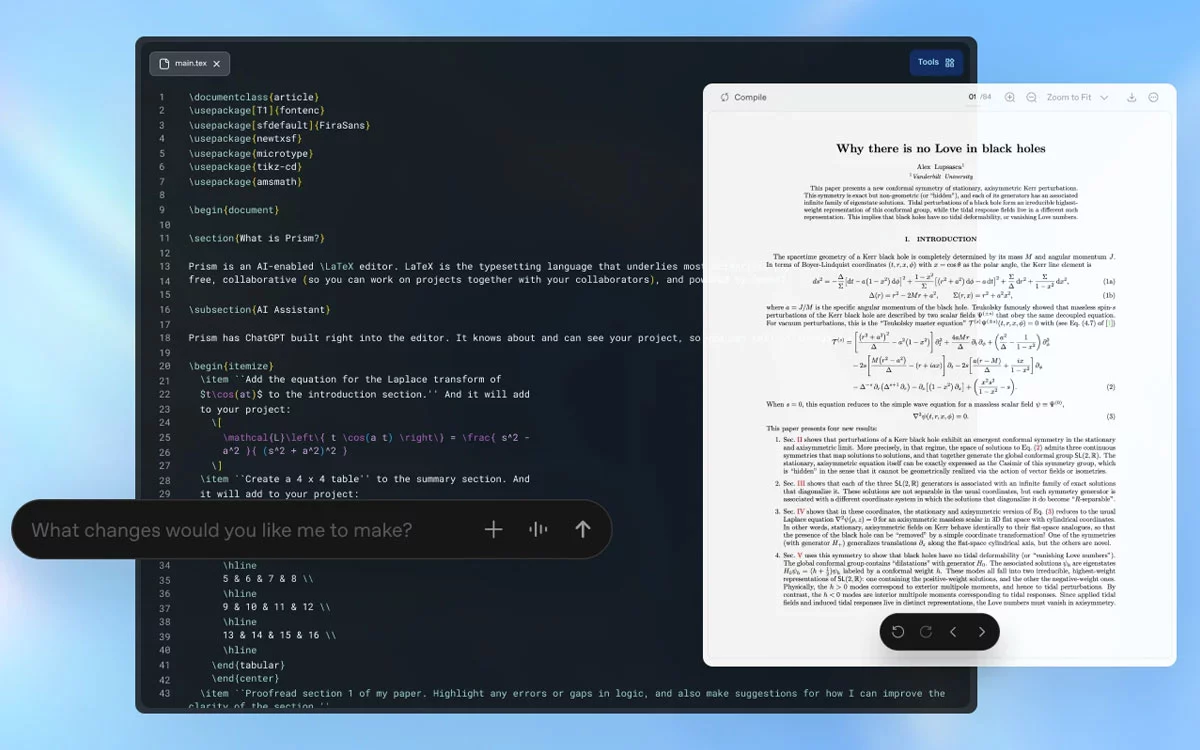
OpenAI launches Prism, placing artificial intelligence at the very center of scientific work. This new workspace, integrated with GPT-5.2 and available for free within ChatGPT, promises to transform the way papers are written, reviewed, and structured. The idea is simple yet ambitious: to turn AI into an active assistant in the scientific process, capable of remembering the project, handling LaTeX, generating diagrams from sketches, and maintaining coherence between different versions of a document.
For many researchers, the launch of Prism marks a turning point. Tasks that usually consume days—polishing academic writing, reviewing references, organizing sections, correcting formulas, reformulating hypotheses, or generating visual schemes—can now be resolved in minutes. If software development has already experienced a productive revolution thanks to AI, Prism aims to bring that same leap to research work.
What is Prism and why does it change the dynamics of papers
Prism functions as an intelligent scientific editor. It is not a conventional word processor, but an environment that understands the project, remembers previous versions, and maintains consistency in arguments, citations, and structures. Its ability to integrate LaTeX eliminates one of the most frustrating barriers for researchers: the complexity of writing formulas, formatting tables, or generating mathematical expressions.
Moreover, Prism allows for creating diagrams from simple sketches or textual descriptions, streamlining the production of figures for academic articles. This includes process schemes, experimental flows, model architectures, or statistical representations.
The key feature, according to those who have already tried it, is the contextual memory of the project: Prism remembers concepts, decisions, and changes; avoids internal contradictions; allows for updating definitions without rewriting the entire document; and maintains coherence between abstract, methodology, and conclusions.
A direct impact on scientific productivity
The promise of Prism is significant: to accelerate the pace of scientific production, something that laboratories have needed for a long time. Today, a large part of academic work is consumed in repetitive tasks, style corrections, and strict formatting. Prism automates these processes and frees up time for what really matters: designing experiments, analyzing data, questioning results.
Researchers highlight three immediate advantages:
-
Assisted academic writing: Prism suggests improvements in clarity, tone, and precision without losing rigor.
-
Project management: remembers hypotheses, variables, methodological decisions, and incorporates them into later versions.
-
Generation of visualizations: creates technical diagrams without the need for specialized software.
The result is a more dynamic and much less bureaucratic research cycle.
What about authorship?
The advancement, however, raises an inevitable debate: how is the authorship of a paper defined when part of the text or diagrams are produced by AI? Scientific journals have already begun to establish rules: AI cannot be listed as an author, but its use must be declared. Prism reignites that debate because its intervention is deeper than a simple writing aid: it participates in the structuring of the work, its coherence, and its formal presentation.
This raises uncomfortable questions in the scientific community:
- What level of AI participation is acceptable?
- Can it distort the interpretation of results?
- How to ensure rigor if part of the document is produced by a model?
- Will accelerated productivity compromise peer review?
Experts point out that Prism will be a powerful tool, but intellectual responsibility will still rest with the researchers. AI does not validate results or interpret experimental data with human judgment; it only organizes, writes, and represents information.
AI in the lab: a new paradigm
Prism joins a growing trend: the integration of AI in all stages of scientific work, from experimental planning to data analysis. In biology, physics, and computational science laboratories, AI is already involved in simulating molecules, optimizing protocols, and detecting patterns that are impossible to see with the naked eye.
The novelty is that it now also enters the construction of the scientific narrative, a territory that until now was considered strictly human. With Prism, OpenAI bets that researchers will abandon technical friction and focus on scientific creativity.
Will it accelerate science… or the debate?
Prism arrives with praise, but also with warnings. Advocates believe that the tool will lead to faster, more accessible, and collaborative science. Its detractors fear that the homogenization of style, excessive AI intervention, and the risk of undetected errors will pose ethical and quality challenges.
What is certain is that Prism opens a new chapter: one in which artificial intelligence not only analyzes data but participates in the construction of knowledge. And in that scenario, the rules of the game are still being written.